
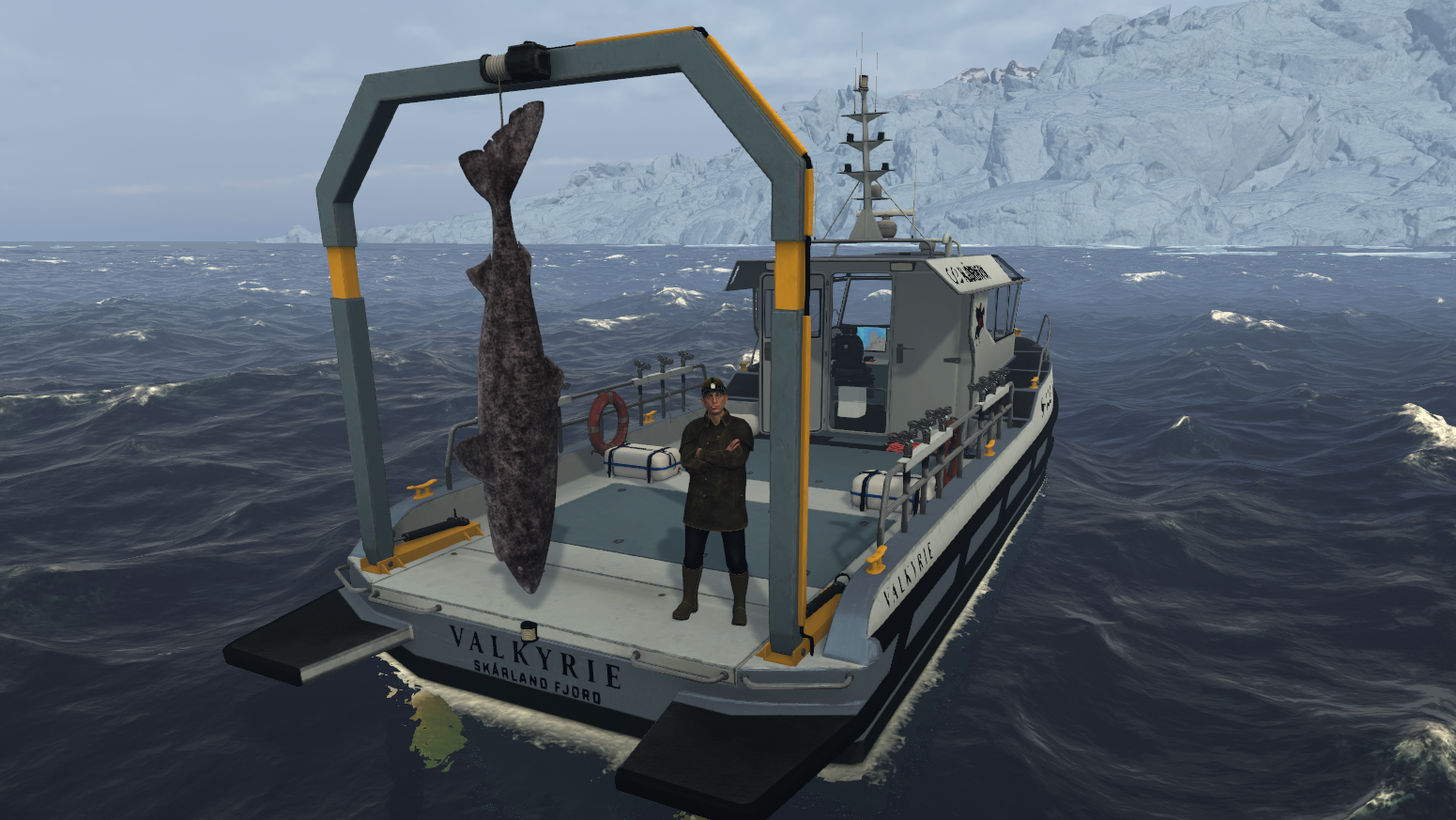
Skårland Fjord is not a map you wander into. It sits at Level 105, deep in Norway’s Sørfold region, and by the time it opens on your globe you are already a serious angler with a boat, an electric reel or two, and a healthy fear of losing a fight to something the size of a car door. I fish it on my own Level 106 account, and after enough trips out into that cold Norwegian Sea I have settled on a rig and a routine that actually works instead of one that just looks impressive in the shop. This is that setup, plus a straight look at every fish the fjord holds and which of my rods I hand each one.
If you are nowhere near Level 105 yet, this guide will still make sense, but your money is better spent earlier. Start with the fundamentals in the Fishing Planet Level 5 spinning setup and the Level 6 casting setup, then come back here when you can afford the ride. Skårland Fjord rewards patience and punishes rushing, so there is no shame in arriving late and prepared.
What Is Skårland Fjord in Fishing Planet?
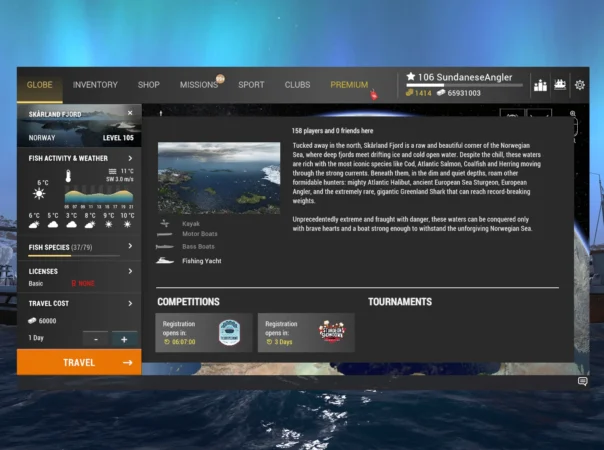
Skårland Fjord is a cold saltwater waterway in the Sørfold Municipality of Norway, unlocked at Level 105. It is an endgame boat map: drifting ice, deep drop-offs, and open Norwegian Sea water that runs from a shallow coastal shelf down into channels where the real monsters live. The species list is a who’s who of North Atlantic heavyweights like Atlantic Cod, Halibut, Common Ling, European Sea Sturgeon, and the almost mythical Greenland Shark, mixed with fast schooling fish like Herring and Mackerel up near the surface.
Here is the honest framing that most guides skip: Skårland Fjord is a bottom-fishing and deep-water map first, and a spinning map a distant second. The trophies that make the trip worth it live on or near the seabed, and you catch them by anchoring over the right depth with heavy tackle and the right bait, not by casting spoons all day. Keep that in mind before you spend a single coin on gear.
Skårland Fjord at a Glance
| Detail | Value |
|---|---|
| Unlock Level | 105 |
| Region | Sørfold Municipality, Norway (Europe) |
| Travel Cost | 50,000 coins |
| Extend Cost | 10,000 coins per extra day |
| License Violation Fine | 7,000 coins |
| 1-Day Basic License | 15,000 coins |
| 1-Day Advanced License | 22,000 coins |
| Boat Fishing | Yes (Kayak, Motor Boats, Bass Boats, Fishing Yacht) |
| Water | Cold saltwater, Norwegian Sea (approx. 3-11°C) |
One number worth flagging: this is an expensive day out. Between the 50,000 travel cost and a license, you are past 65,000 before you have baited a single hook. That is before repairs, extra bait, or extending the trip. Do not travel to Skårland Fjord on your last coins. I treat 100,000 as the realistic floor for a proper session with a buffer. I would rather farm one more day at a cheaper map than arrive here broke and forced to leave after one slow tide.
Which License Do You Need at Skårland Fjord?
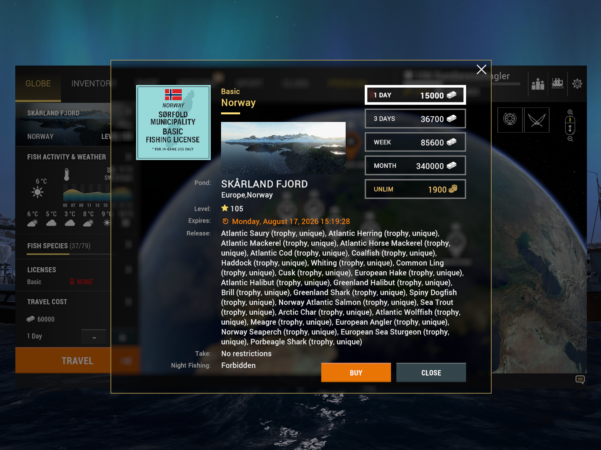
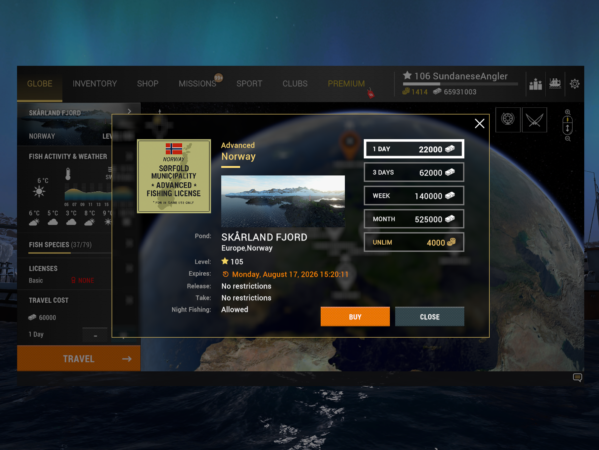
The Sørfold Municipality sells two licenses, and the gap between them matters more than the price. The Basic license starts at 15,000 coins for one day and scales up to a 30-day pass; the Advanced license starts at 22,000 for a day and climbs to 525,000 for 30 days, with unlimited passes sold in bait tokens. Fishing without one costs you a 7,000-coin fine per violation, which is the fastest way to bleed money on this map.
My rule of thumb: buy the day pass that matches your plan and no more. If you are here to grind cod and ling for a few hours, the Basic day license does the job. If you are hunting the premium deep species and plan to keep everything worth keeping, the Advanced license pays for itself. Only step up to a 7-day or 30-day pass once you know you are coming back. Buying a 30-day pass for a single trip is just handing coins to the game.
The Three-Rod System I Run at Skårland Fjord
This is the part I actually care about, and the part that took real time on the water to get right. Skårland Fjord holds fish that range from a one-kilo Whiting to a 700-kilo Greenland Shark, and no single rod covers that spread. So I keep three saltwater bottom casting electric rods rigged and ready, each tuned to a weight class. When a mark shows up on the sounder, I already know which rod to reach for. No re-rigging on the spot, no losing the window.
All three are electric rods, because winching a heavy fish up from deep water by hand in this game is a good way to snap off or run your line to nothing. Here is each one, why it earns its slot, and what I send it after.
The Giant Rod: PulseWave 170 SE
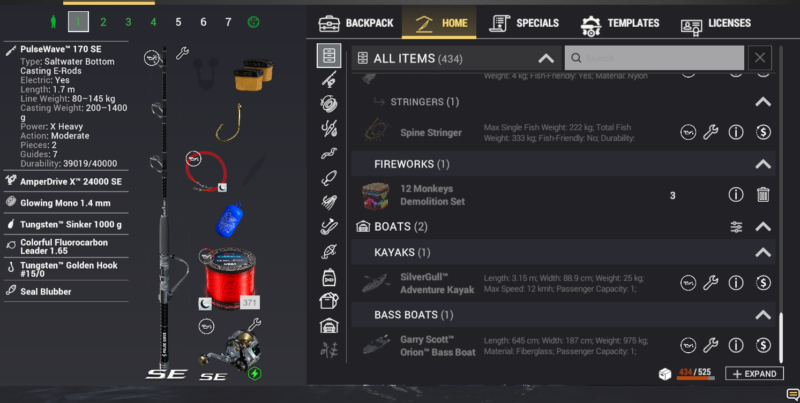
| Component | Item |
|---|---|
| Rod | PulseWave 170 SE (Saltwater Bottom Casting E-Rod) |
| Length / Power / Action | 1.7 m / X Heavy / Moderate |
| Line / Casting Weight | 80-145 kg / 200-1400 g |
| Reel | AmperDrive X 24000 SE |
| Main Line | Glowing Mono 1.4 mm |
| Leader | Colorful Fluorocarbon Leader 1.65 |
| Hook | Tungsten Golden Hook #15/0 |
| Sinker | Tungsten Sinker 1000 g |
| Bait | Seal Blubber |
This is the leviathan rod, full stop. The #15/0 hook, the kilogram of tungsten holding bottom, and the Seal Blubber on the hook all point at one thing: the Greenland Shark. Seal Blubber is one of the few baits that fish actually eats, and the mono plus heavy fluoro leader give me the abrasion resistance and stretch I want when something over 400 kg finally commits. I also drop this rig for the largest Halibut and Sturgeon marks, but honestly, when the PulseWave is out, I am shark hunting and everything else is a bonus.
The Toothy-Fish Rod: Chillarc 180 SE
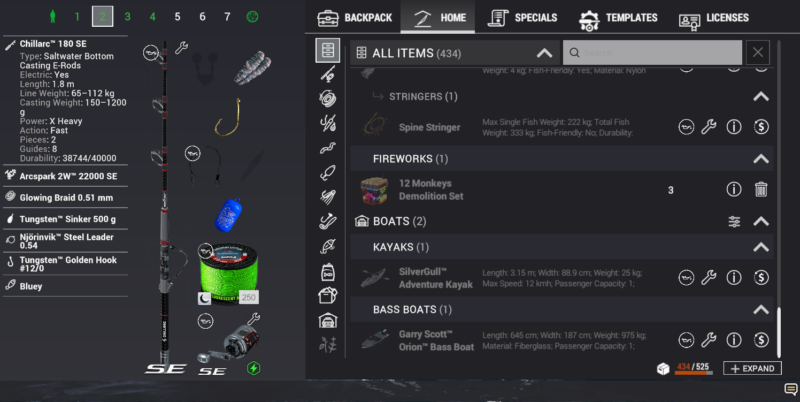
| Component | Item |
|---|---|
| Rod | Chillarc 180 SE (Saltwater Bottom Casting E-Rod) |
| Length / Power / Action | 1.8 m / X Heavy / Fast |
| Line / Casting Weight | 65-112 kg / 150-1200 g |
| Reel | Arcspark 2W 22000 SE |
| Main Line | Glowing Braid 0.51 mm |
| Leader | Njörinvik Steel Leader 0.54 |
| Hook | Tungsten Golden Hook #12/0 |
| Sinker | Tungsten Sinker 500 g |
| Bait | Bluey |
The steel leader is the whole point of this rod. Skårland Fjord is full of fish that will shear straight through fluorocarbon. Atlantic Wolffish with its bone-crushing jaws, Spiny Dogfish, and Porbeagle Shark all have the teeth to end a fight before it starts, and the Njörinvik steel leader takes that off the table. The braid gives me direct, no-stretch feel for the bite, which matters at depth, and the #12/0 hook with Bluey covers the mid-heavy predators: Porbeagle, big Halibut, European Angler, Sea Sturgeon, and the dogfish. If a fish in this fjord has teeth or attitude, it meets the Chillarc.
The Workhorse Rod: Sigma F 200 NE SE
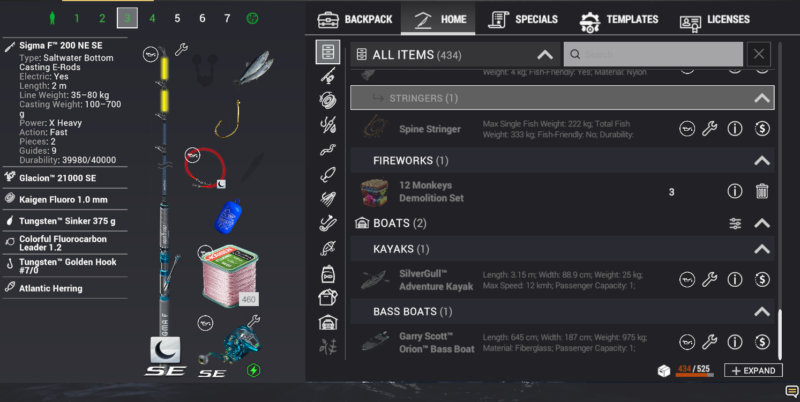
| Component | Item |
|---|---|
| Rod | Sigma F 200 NE SE (Saltwater Bottom Casting E-Rod) |
| Length / Power / Action | 2.0 m / X Heavy / Fast |
| Line / Casting Weight | 35-80 kg / 100-700 g |
| Reel | Glacion 21000 SE |
| Main Line | Kaigen Fluoro 1.0 mm |
| Leader | Colorful Fluorocarbon Leader 1.2 |
| Hook | Tungsten Golden Hook #7/0 |
| Sinker | Tungsten Sinker 375 g |
| Bait | Atlantic Herring |
This is the rod that actually pays for the trip. It is the lightest of the three but still X Heavy, and the #7/0 hook with Atlantic Herring is a magnet for the entire cod family: Atlantic Cod, Coalfish, Common Ling, Cusk, Haddock, European Hake, and Norway Seaperch all take herring on the bottom. These are your steady coins and XP between the trophy hunts. When I want consistent action rather than one heart-stopping fight, the Sigma F stays out and the herring keeps working.
What This Setup Does Not Cover
Being honest about the gaps is what keeps a guide useful. These three rods are all heavy bottom rigs, and they are useless for the fjord’s fast surface fish. Norway Atlantic Salmon, Sea Trout, Arctic Char, Mackerel, Horse Mackerel, Herring, and Saury are pelagic or coastal fish that want a spinning setup with light lures like spoons, spinners, plugs, and nano baits, not a kilogram of tungsten pinning bait to the seabed. If those species are your goal, bring a separate saltwater spinning rod. I do not chase them here, because I come to Skårland Fjord for the giants, but you should know the bottom rig will never reach them.
Boat and Essentials for Skårland Fjord
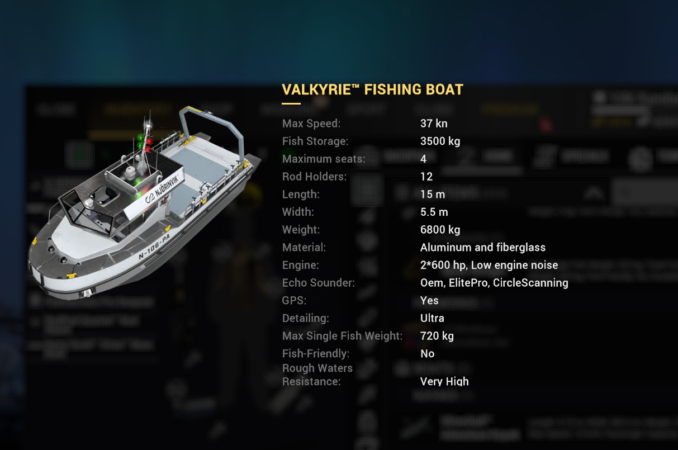
| Valkyrie Fishing Boat Spec | Value |
|---|---|
| Max Speed | 37 kn |
| Fish Storage | 3,500 kg |
| Maximum Seats | 4 |
| Rod Holders | 12 |
| Length / Width | 15 m / 5.5 m |
| Weight | 6,800 kg |
| Material | Aluminum and fiberglass |
| Engine | 2 x 600 hp, low engine noise |
| Echo Sounder | Oem, ElitePro, CircleScanning |
| GPS | Yes |
| Detailing | Ultra |
| Max Single Fish Weight | 720 kg |
| Fish-Friendly | No |
| Rough Waters Resistance | Very High |
The boat matters as much as the rod on a map like this. I run the Valkyrie Fishing Boat: 3,500 kg of fish storage, 12 rod holders, a crane for big fish, very high rough-water resistance, and a proper echo sounder with GPS. Those last two are not luxuries here. The sounder is how you read the depth changes and find the drop-offs where the big fish sit, and the crane is what lands a Greenland Shark that a normal net could never handle. Skårland Fjord is open, cold, and rough, so a small bass boat will fight the water instead of the fish.
Two more essentials: a stringer or fish storage rated for genuinely heavy single fish, and a warm-clothing item so you can stay out through the productive windows. Turning up with a keepnet that maxes out at a fraction of a trophy’s weight is a mistake I made once and never again.
Best Spots: Reading the Skårland Fjord Depth Map
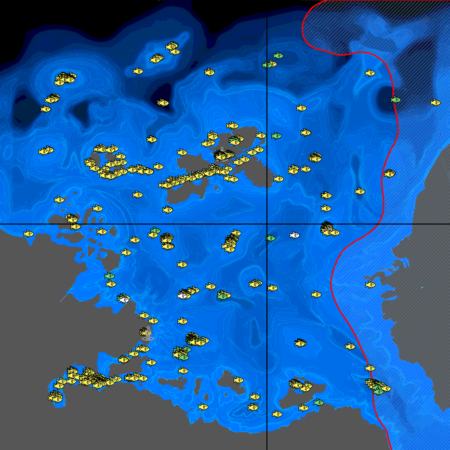
The depth map tells the whole story of how to fish this place. The lighter blue shelf areas to the north-west and south-west are packed with fish markers. That is where the schooling and mid-water fish concentrate, and where the cod-family action is fastest. The darker water and the red line running down the eastern side mark the deep channel and the map boundary; that steep drop-off is where the true deep-water giants hold. If you want cod, ling, and haddock, anchor over the busy shelf. If you want a shark, a big halibut, or a sturgeon, work the edge of that deep channel and let the bait sit on or just above the bottom.
Fish activity swings hard with time of day here, same as anywhere. Watch the activity graph, use the time-skip to reach the peak windows rather than grinding through a dead tide, and do not keep moving spots every few minutes. On a deep map, giving a good mark time to find your bait beats constant repositioning.
Every Fish at Skårland Fjord and How to Catch It
Skårland Fjord holds over two dozen species. Rather than dump a bait list on you, I have grouped them by how you actually fish for them and noted which of my three rods each one gets. Baits and lures below are the in-game preferences; the rod call is mine.
Deep-Water Giants (Chillarc 180 / PulseWave 170)
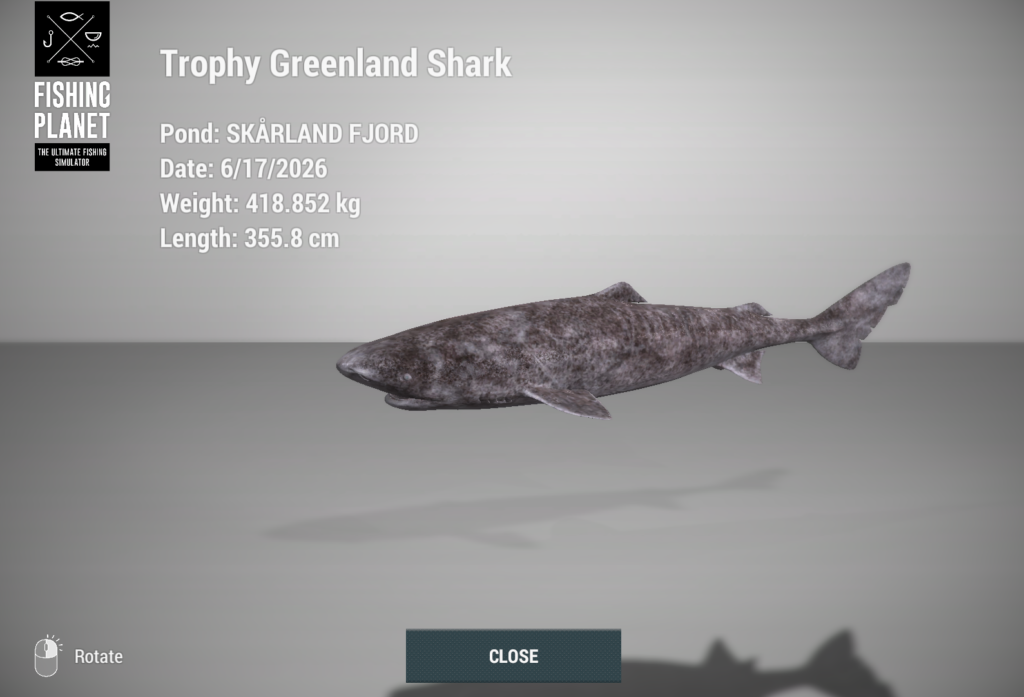
Greenland Shark
The prize of the whole map and one of the largest fish in the game, a slow, ancient deep-ocean giant that prowls the coldest, darkest water in the fjord. It rarely takes bait, so targeting it is a waiting game more than a fishing one. You need to be set up over genuinely deep ground before it will even consider your hook.
Being an opportunistic feeder that eats things most fish ignore is why oily, meaty baits win here. Seal Blubber is my first choice, with Fish Head and Large Fish Strips as backups, and Bluey or Gutted Fish also on its menu. I drop the PulseWave 170 with its #15/0 hook and a kilogram of tungsten straight into the deep channel and let it sit. This is not a fish you farm. It is a fish you earn, and landing one is the reason the heaviest rod stays rigged all day.
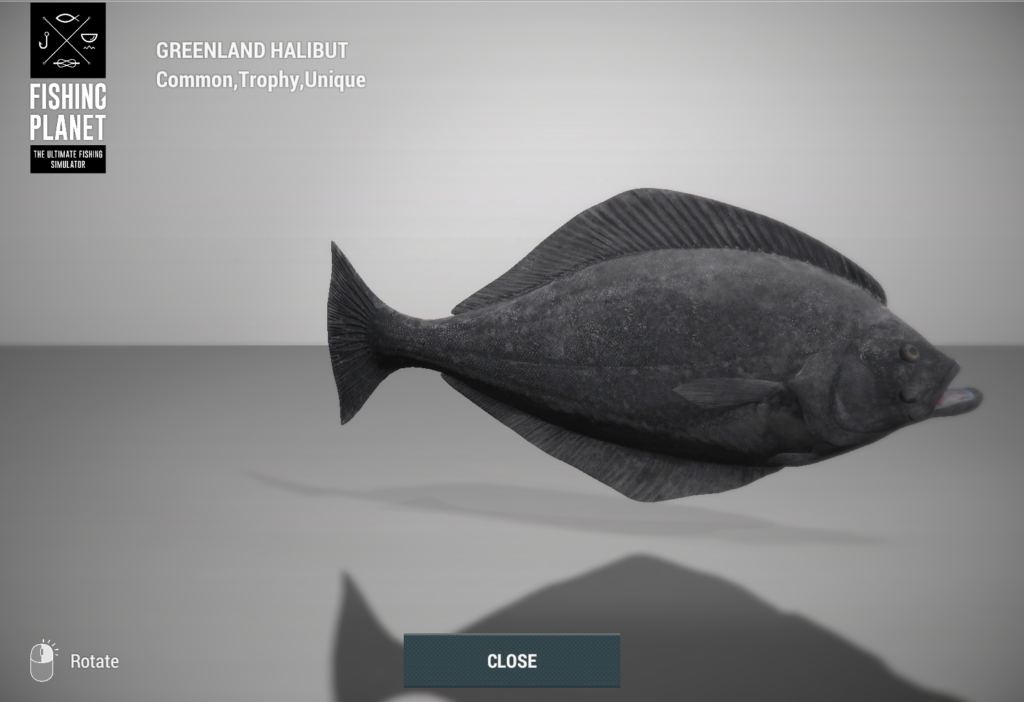
Greenland Halibut
A deep-water flatfish that holds far down near underwater ridges and canyons, usually in the deepest water the map offers. Most run mid-size, but the big ones are genuine trophies, and they feed on herring, cod, squid, and deepwater crustaceans, so a fish-based bait pinned hard on the bottom is the play. I fish the Chillarc or PulseWave with Atlantic Herring, Bluey, or Mackerel cut baits, and when I want to jig for them, Nordic Pilkers and Glowing Squids both produce down deep. Get to the bottom, keep contact with your sinker, and expect a heavy, dogged fight rather than a fast run.
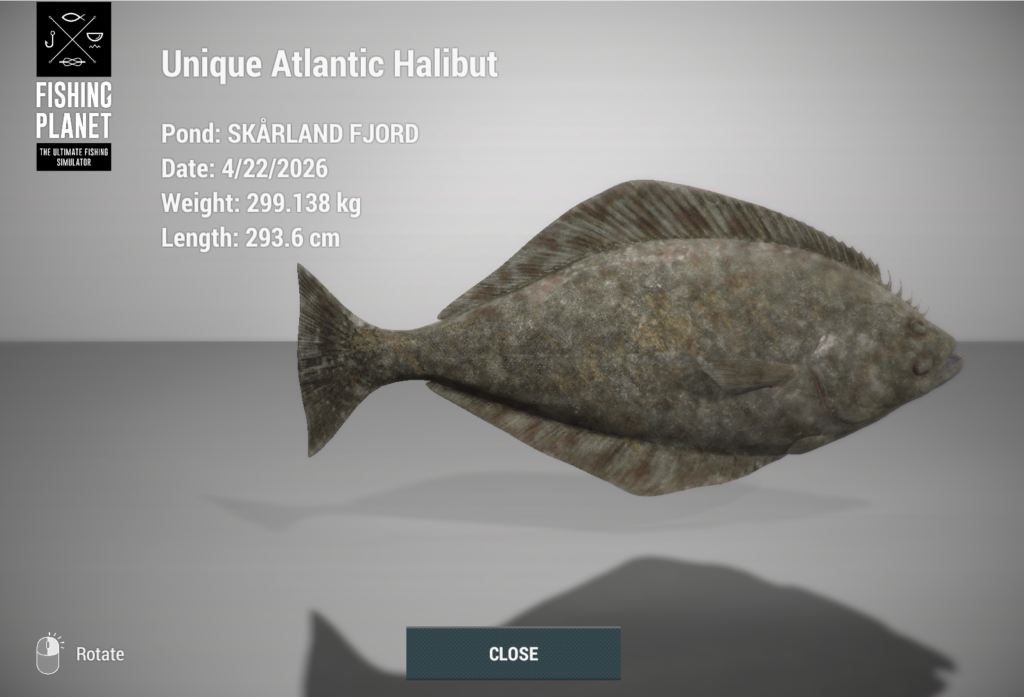
Atlantic Halibut
One of the map’s true trophies, this is one of the largest flatfish in the world and big enough to demand the heavy rods and serious patience. It sits on rocky and sandy sea floors at depth and ambushes herring, cod, squid, and crustaceans, striking both natural bait and large lures. My go-to baits are Bluey, Atlantic Mackerel cut baits, and Large Fish Strips on the Chillarc, and I step up to the PulseWave the moment I mark a really big one. If you would rather work lures, Nordic Pilkers, Baby Halibuts, and Glowing Squids all take fish on the bottom. Hooking one is a test of endurance, so keep your drag sensible and never try to muscle it.
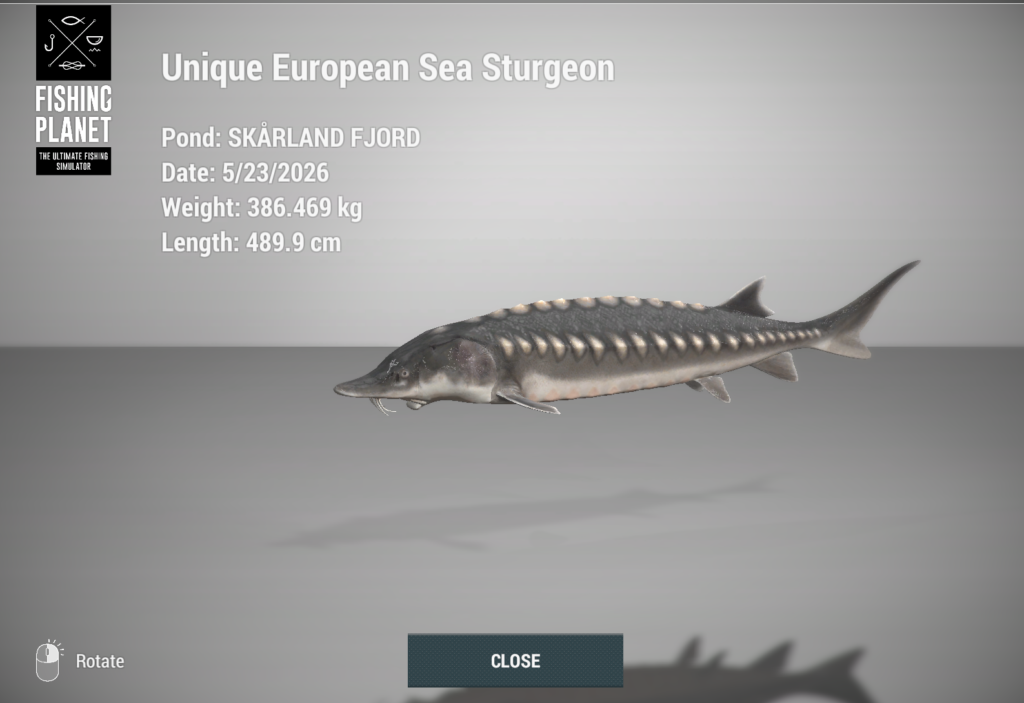
European Sea Sturgeon
One of the rarest and heaviest fish native to European waters, an ancient bottom feeder that can push past 400 kg. It prefers clean, well-oxygenated water over sandy or gravelly ground, and it is strictly a bait fish with no lures on its menu at all. Bluey, Large Fish Strips, and Black Lugworms are the reliable choices, with crab and shrimp baits also in play, all planted flat on the seabed. I run it on the Chillarc or PulseWave with heavy-duty terminal tackle, because a sturgeon that commits will test every knot you tied. This one is all bait, precise placement in deep water, and patience.
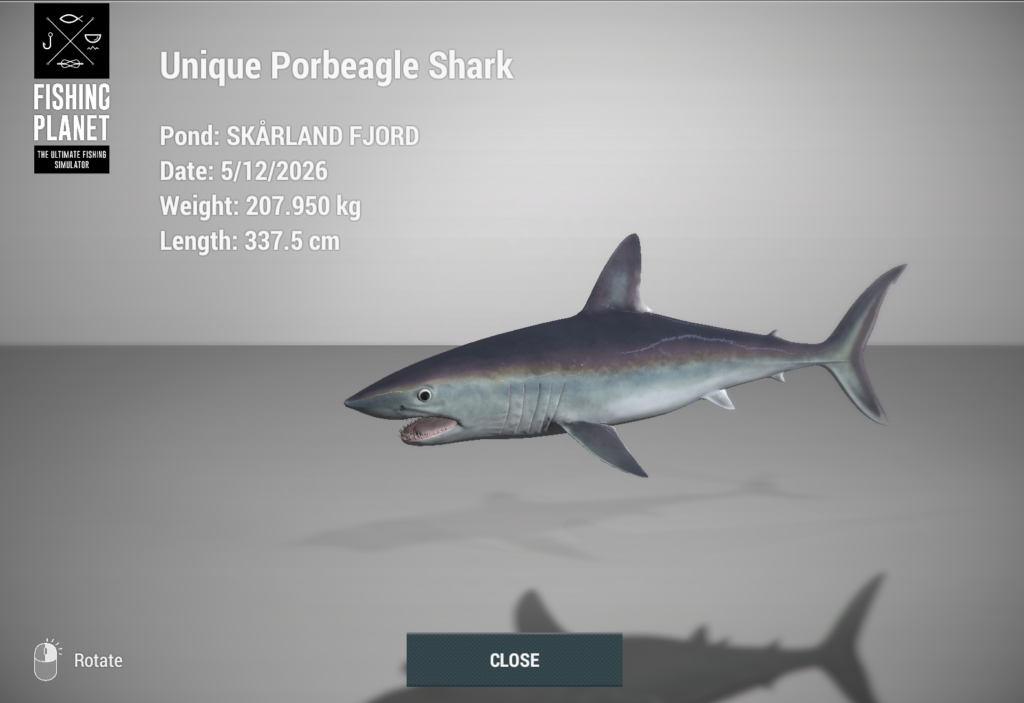
Porbeagle Shark
A fast open-water predator built for explosive bursts and long, sustained runs through cold water. It hunts mackerel, herring, and cod along the shelf edges and thermal fronts, and it will bite through anything that is not steel, which is exactly what the Chillarc’s Njörinvik steel leader is for. Bluey, Gutted Fish, Fish Head, and Large Fish Strips are its baits, and Nordic Pilkers can tempt one on the drop. When a porbeagle takes, let the electric reel do the lifting and keep steady pressure, because this is one of the most prized trophies of the northern seas and an easy one to lose in a panic.
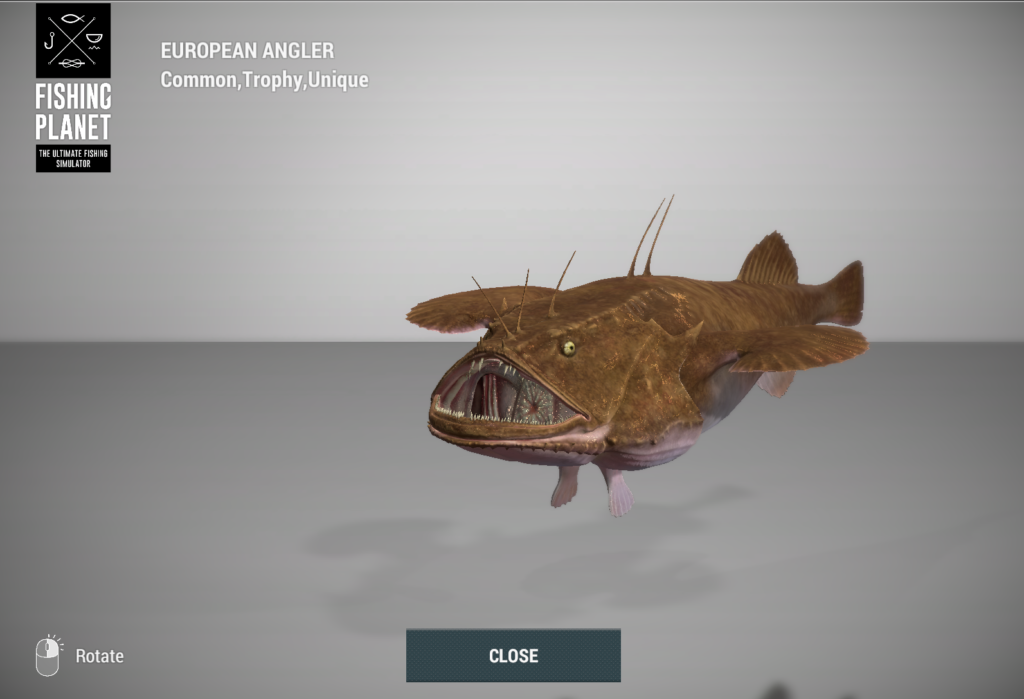
European Angler
The eerie deep-ocean sea devil lurks over sandy and muddy bottoms and uses the fleshy lure on its head to draw prey straight into an enormous mouth. Adults mainly eat fish, and the exceptional specimens get genuinely large, so this is a big-bait, bottom-rig target that fishes best after dark. Scaled Sardines, Atlantic Herring, Mackerel cut baits, and Bluey on the Chillarc are what I use, with softbaits and Nordic Pilkers as lure options. Fish it at night, keep the bait pinned to the bottom, and give it time to commit rather than striking early.
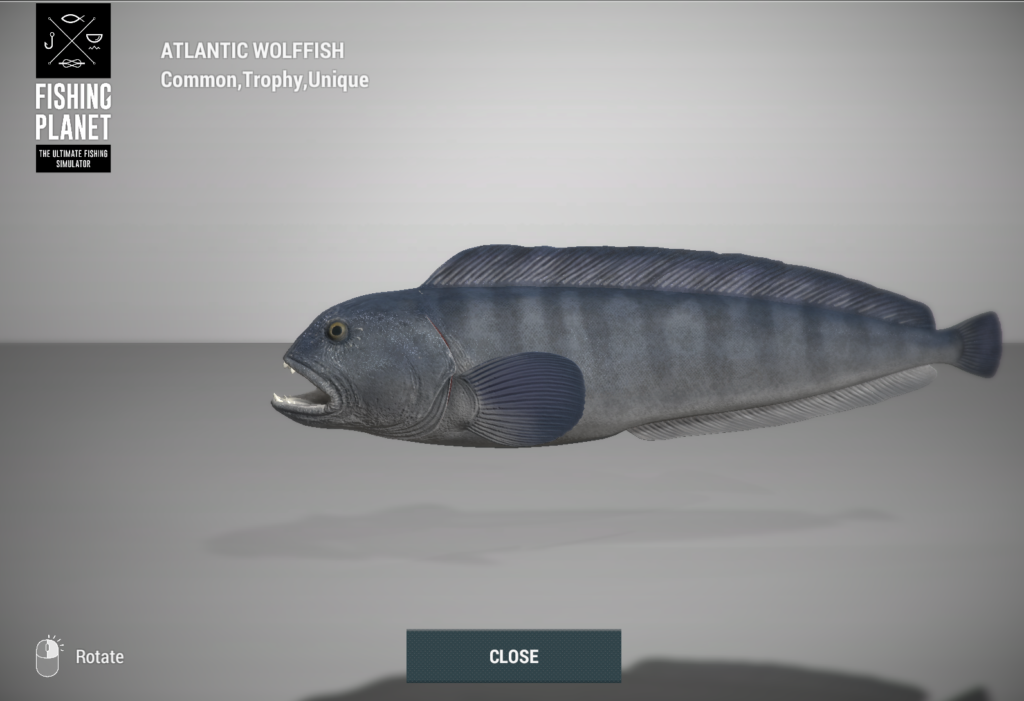
Atlantic Wolffish
A rocky-bottom brute with jaws built to crush hard-shelled prey, which shapes everything about how you target it. It lives near rocky seabeds and underwater cliffs and eats crabs, shrimp, whelks, cockles, and clams, so shellfish and crustacean baits are the natural match: Crab, Peeler Crab, Shrimp, Mussel Meat, and Razor Shell all produce. Those same jaws shred fluorocarbon, so it goes on the Chillarc with its steel leader, no exceptions. Squid Jigs and Nordic Pilkers can also pull one when they move deeper to feed. Even an average wolffish fights hard, and a big one on rocky ground will try to wedge itself into the structure, so keep the pressure on.
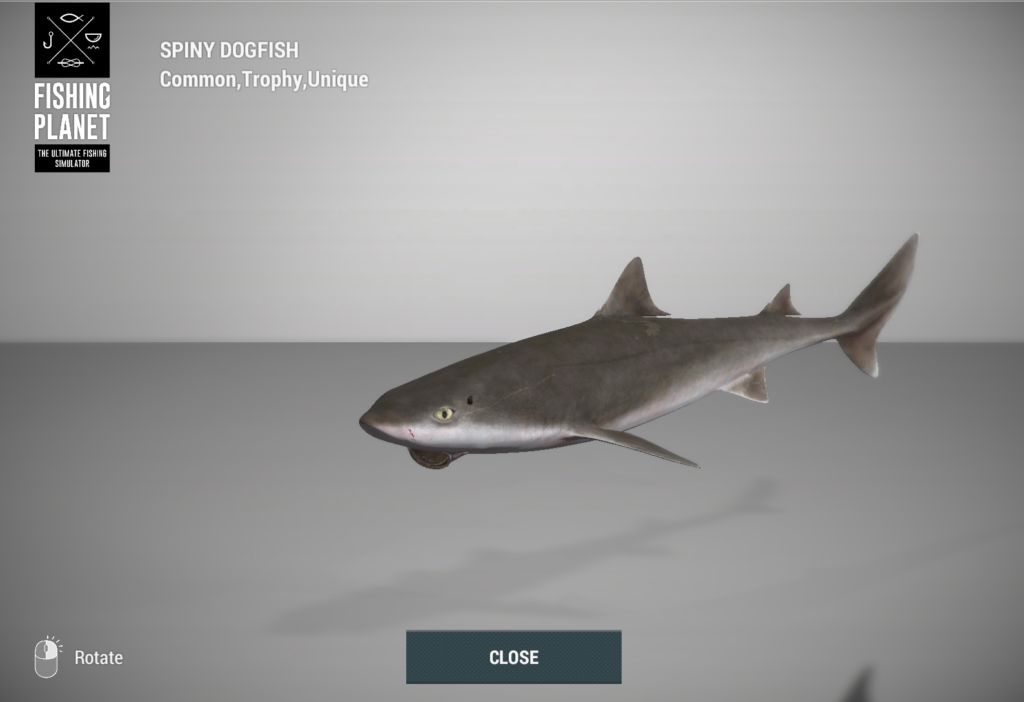
Spiny Dogfish
A small but sharp-toothed shark that roams cold water near rocky bottoms and underwater ridges. It carries two defensive spines and a mouth full of teeth, so strong leaders are a must and this fish earns a spot on the steel-leadered Chillarc. Its diet is herring, cod, flatfish, and shrimp, so Atlantic Herring, Sardines, Mackerel strips, and Bluey all produce, and Nordic Pilkers or Saltwater Slugs work as lures. Not a giant, but fast, slippery, and a dependable catch while you wait on something bigger, and quiet presentation brings more bites than a rushed one.
Cod Family and Bottom Feeders (Sigma F 200)
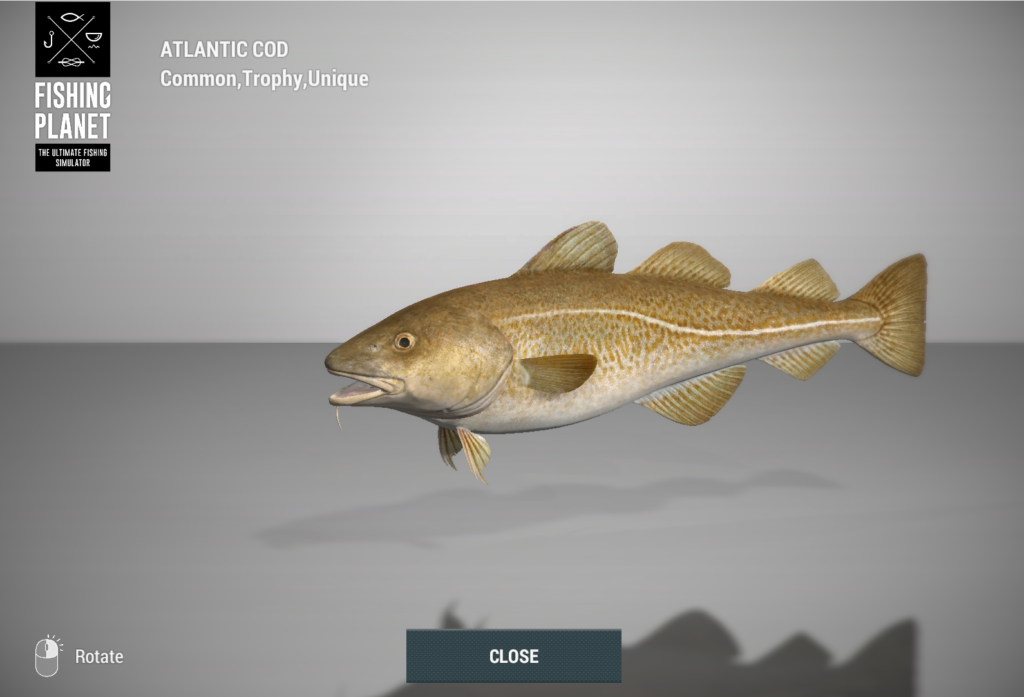
Atlantic Cod
The steady earner and the fish that pays for most of my trips. This is one of the most accessible saltwater species here, active around baitfish schools over rocky and sandy bottoms, and easy to locate once you learn to read the sounder. It happily takes both natural bait and lures, so Atlantic Herring or Scaled Sardines on the Sigma F is my default, while Nordic Pilkers are perfect if you would rather jig. Big cod get genuinely heavy, so do not be shocked when a routine bite turns into a proper fight. Find the schools, keep bait near the bottom, and the coins add up fast.
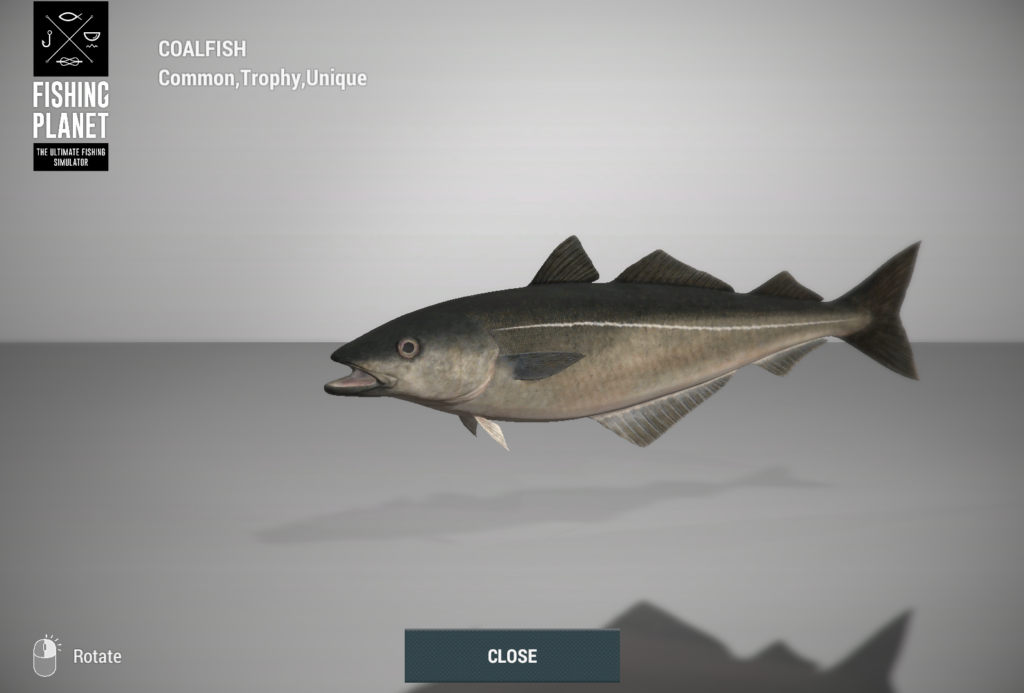
Coalfish
Also known as pollock or saithe, coalfish are fast-swimming schooling predators that are almost always on the move. They hold near reefs, rocky slopes, and continental shelves, chasing herring, cod, and crustaceans, and their aggression makes them one of the most reliable ways to keep the action going. Herring and Sardines on the Sigma F work, but this is also a species where vertical jigging shines, so Nordic Pilkers and Saltwater Twisters over structure are worth trying. They hit hard and fight above their weight, which can turn an otherwise slow session into a busy one.
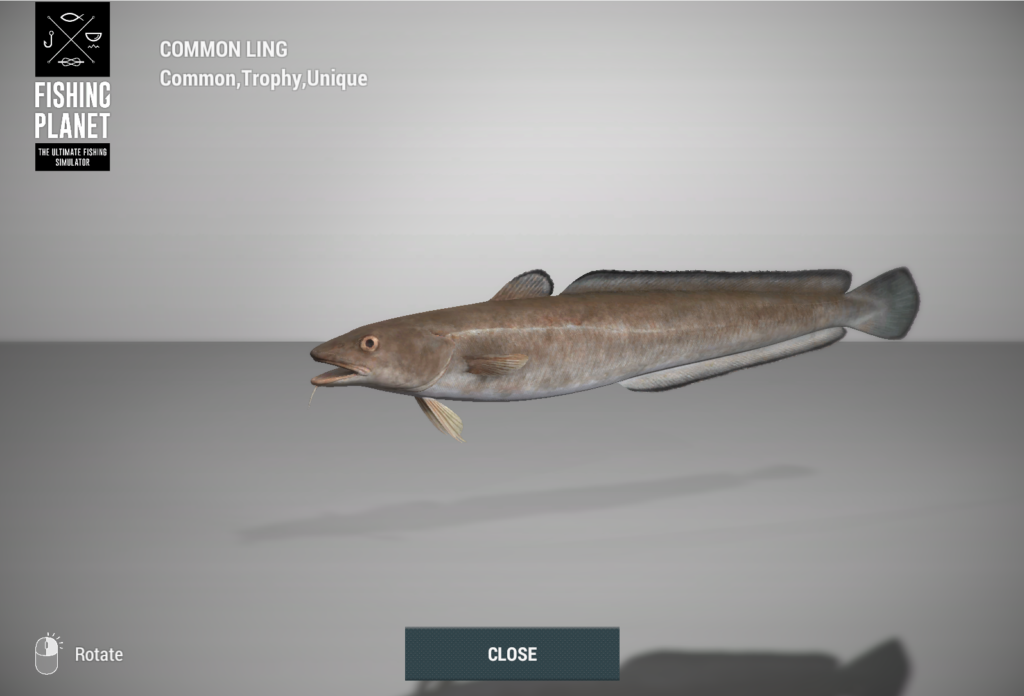
Common Ling
A long-bodied deep-slope predator that reaches serious length and weight. It holds on rocky and sandy ground anywhere from moderate depth down to the deep channel, feeding on herring, flatfish, crustaceans, and mollusks, and it is especially active through the colder months. Herring, Sardines, and cut baits on the Sigma F are my usual approach, and it will also take Nordic Pilkers and Saltwater Slugs on a bottom jig. If you start hooking consistently large ling, bump up to the Chillarc so you are not undergunned when a big one decides to bury itself in the rocks.
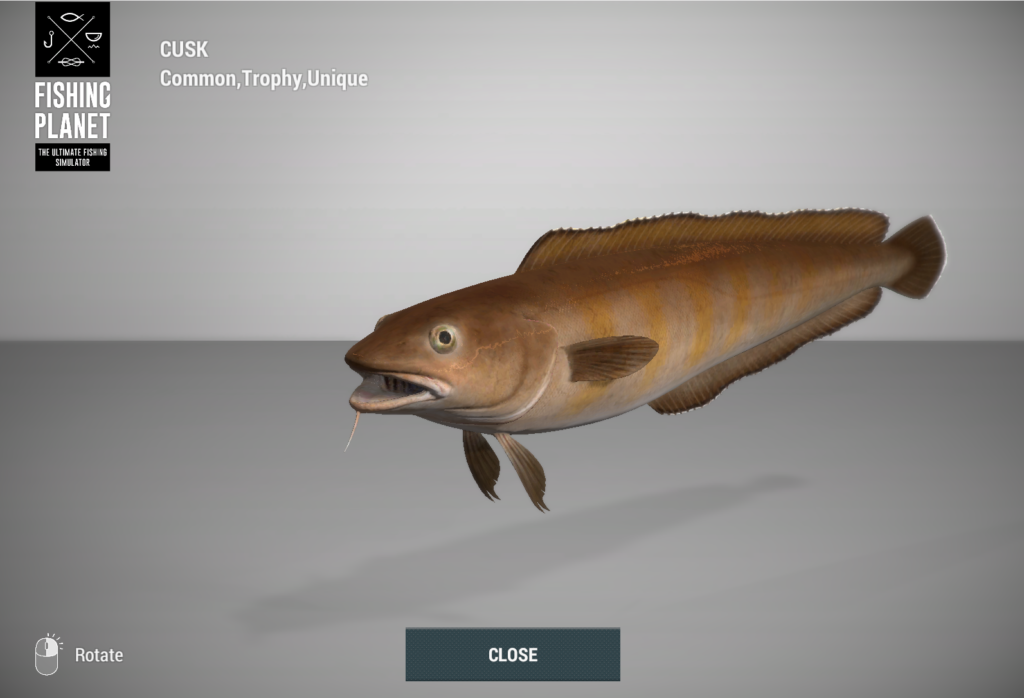
Cusk
A deep-dwelling member of the cod family that likes rough, rocky ground, ledges, and gravel below roughly 180 metres. It is not the most aggressive hunter, feeding steadily on small fish, crustaceans, and mollusks, so a patient bottom presentation suits it best. Sea Worms, Ragworms, Crab, and Shrimp on the Sigma F over broken ground are dependable, and Nordic Pilkers or Glowing Squids can work in the dark. It is a steady rather than spectacular catch, but a welcome one when you are already parked over deep rock waiting on bigger fish.
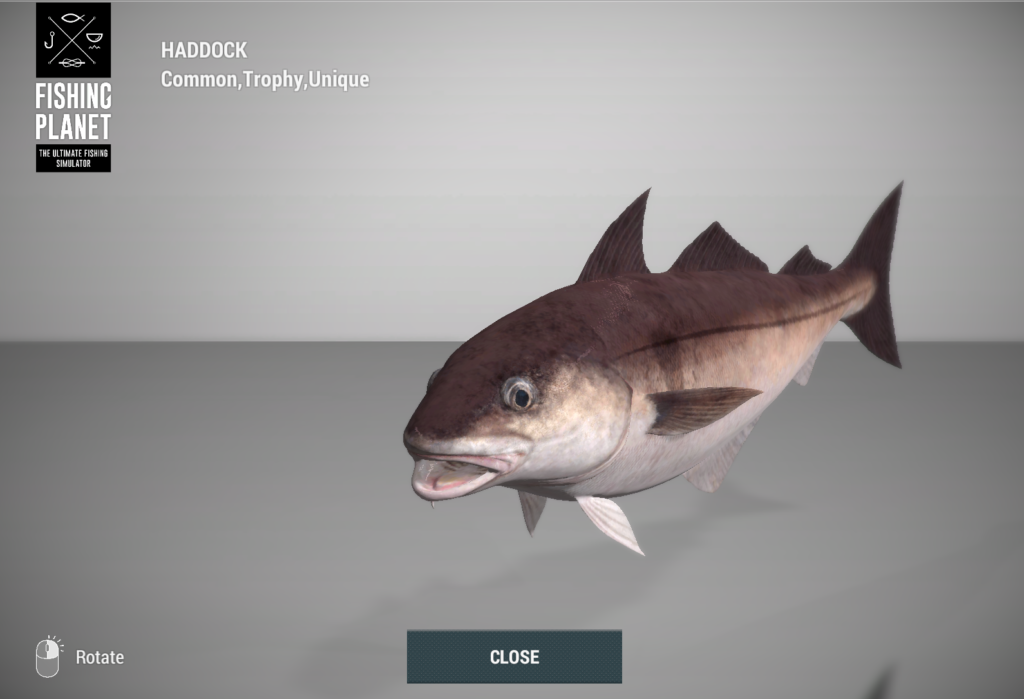
Haddock
One of the easiest bites on an otherwise demanding map, a cod-family bottom dweller that holds over sandy and muddy seabeds. It feeds mostly on small bottom invertebrates like worms and bivalves, plus the occasional small fish, and responds well to both natural bait and mid-size jigs. Worms, Shrimp, and Sand Eel on the Sigma F are all you need, and Nordic Pilkers or Glowing Squids add a lure option. Large haddock get respectable, but most are steady, reliable fish, which makes this a good species to build a keepnet on while you wait for a trophy to show.
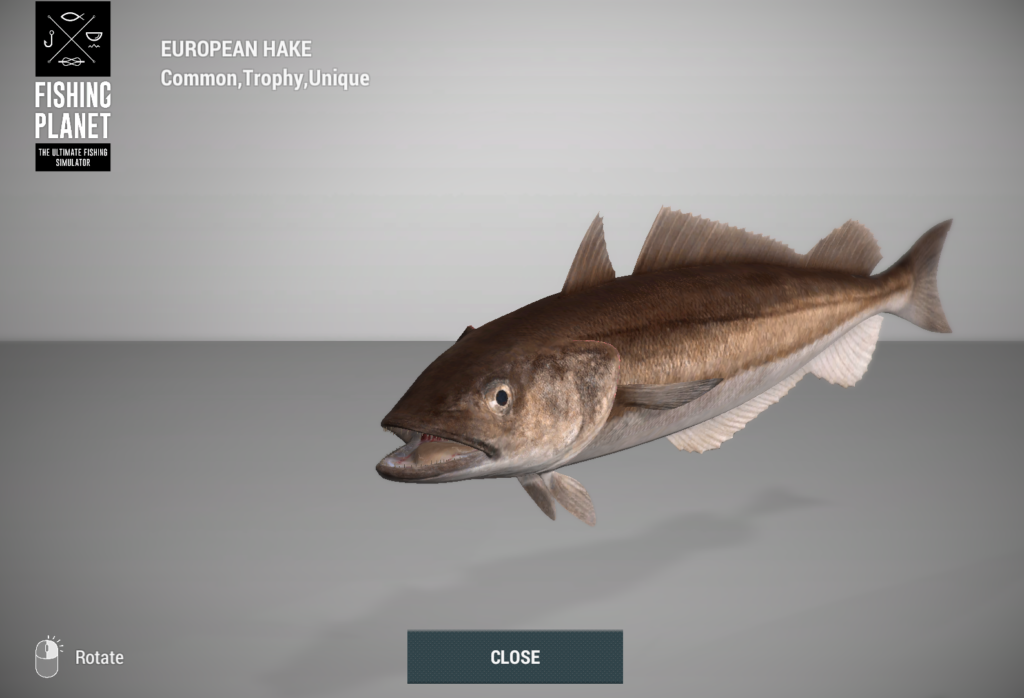
European Hake
A deep, agile predator that really turns on after dark, so timing matters more than gear with this one. It sits between roughly 70 and 300 metres, stays sensitive to changing conditions, and feeds on herring, anchovies, shrimp, and mollusks. Herring and Sardines on the Sigma F over deeper ground work well at night, and a jighead with a luminous sleeve, Glowing Squids, or Nordic Pilkers can be even better in the dark. Fish it through the low-light windows and you will feel the difference in bite rate almost immediately.
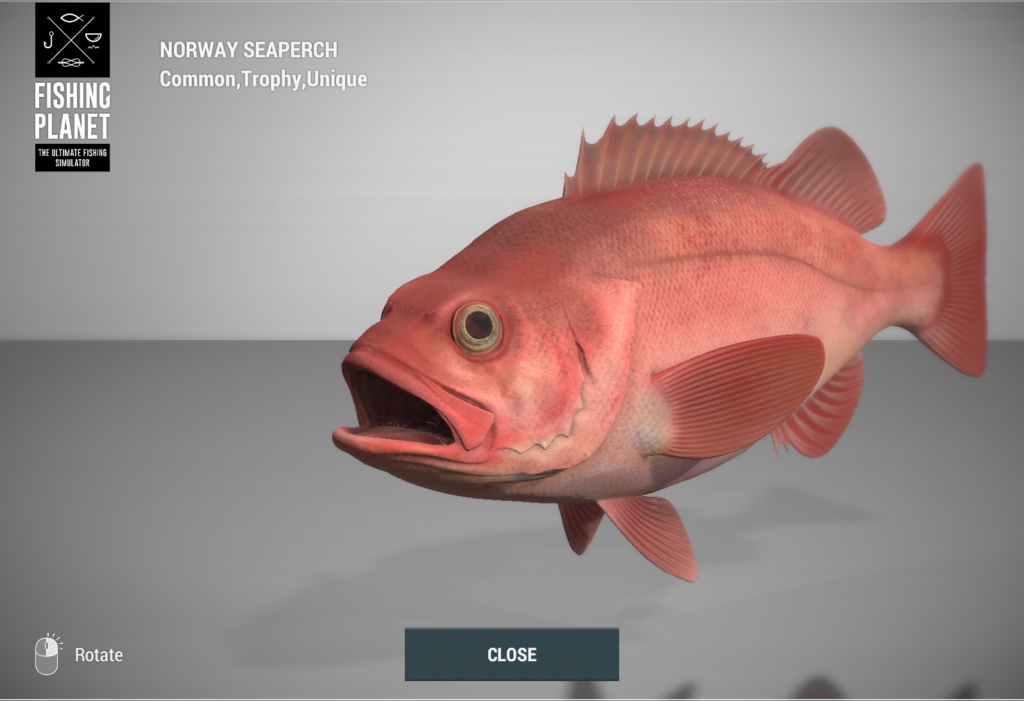
Norway Seaperch
A vivid red deepwater redfish, easily known by its spiny dorsal fin, that thrives near rocky slopes and cold, shadowy drop-offs. Most run around half a metre, but trophy fish reach a full metre and real weight, and they feed on small fish, shrimp, crabs, and squid down between roughly 100 and 500 metres. Scaled Sardines, Atlantic Herring, and Mackerel cut baits on the Sigma F are my choice, and deep-diving lures or Nordic Pilkers work along the edge. Look for them right on the drop-off rather than out over open bottom, because that shadowy structure is where they stack up.
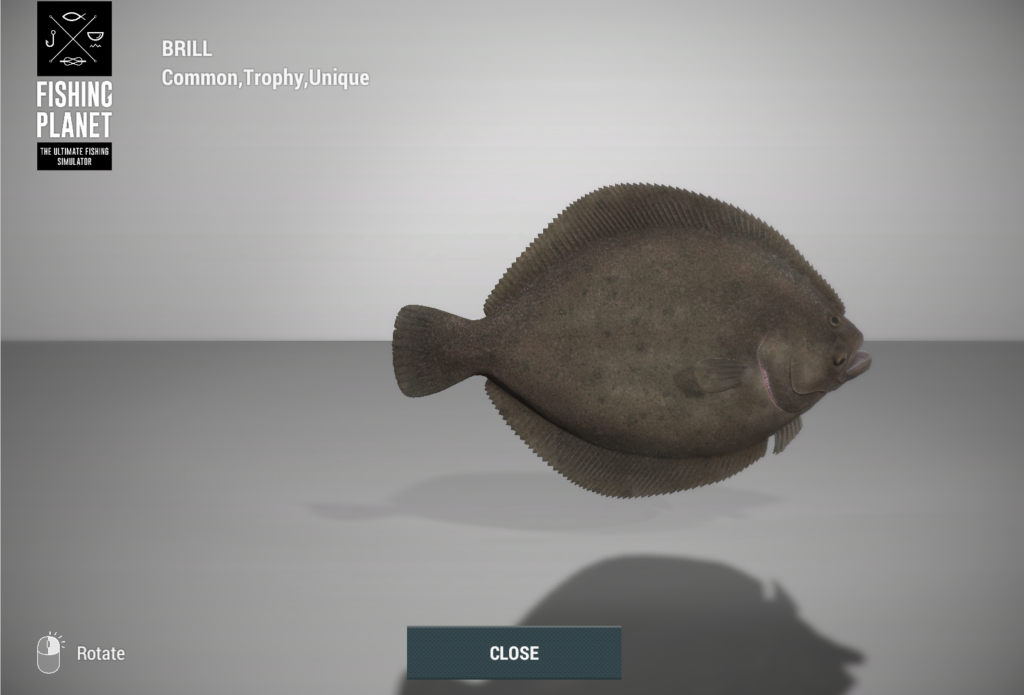
Brill
A sleek, elusive flatfish that hides on sandy and muddy seafloor, usually shallower than the true deep giants, and it is considered a relatively rare catch. It feeds on worms, crustaceans, mollusks, and small fish, and it responds best to bottom rigs with natural bait or soft lures. Sand Eel, Mackerel cut baits, and Sea Worms on the Sigma F are reliable, and because it tucks itself into the seabed, the sounder is your friend for finding the productive patches. Its sensitivity to presentation makes it a genuine challenge, so keep your rig tidy and your bait natural.
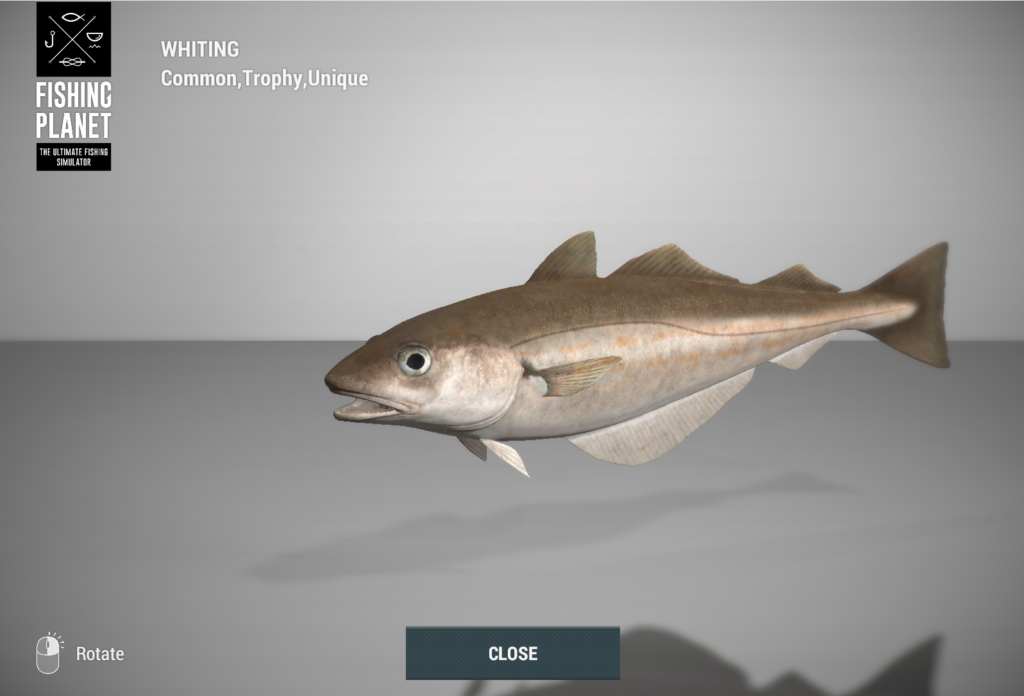
Whiting
The smallest bottom target here, a schooling cod-family fish that is easy, quick, and a good beginner catch on an advanced map. It holds between roughly 30 and 100 metres, feeding on small fish, crustaceans, and marine worms, and it responds well to natural baits and small pilkers. Worms and small baits will do, and the #7/0 Sigma F rig is honestly overkill for it, but a whiting that swims by while you wait on something bigger is a free fish. Do not build a session around it, but do not turn it away either.
Pelagics and Salmonids (Spinning Setup Needed)
Everything below wants a spinning rod and light lures, not the bottom rigs above. If you plan to target these, pack a separate saltwater spinning outfit before you travel.
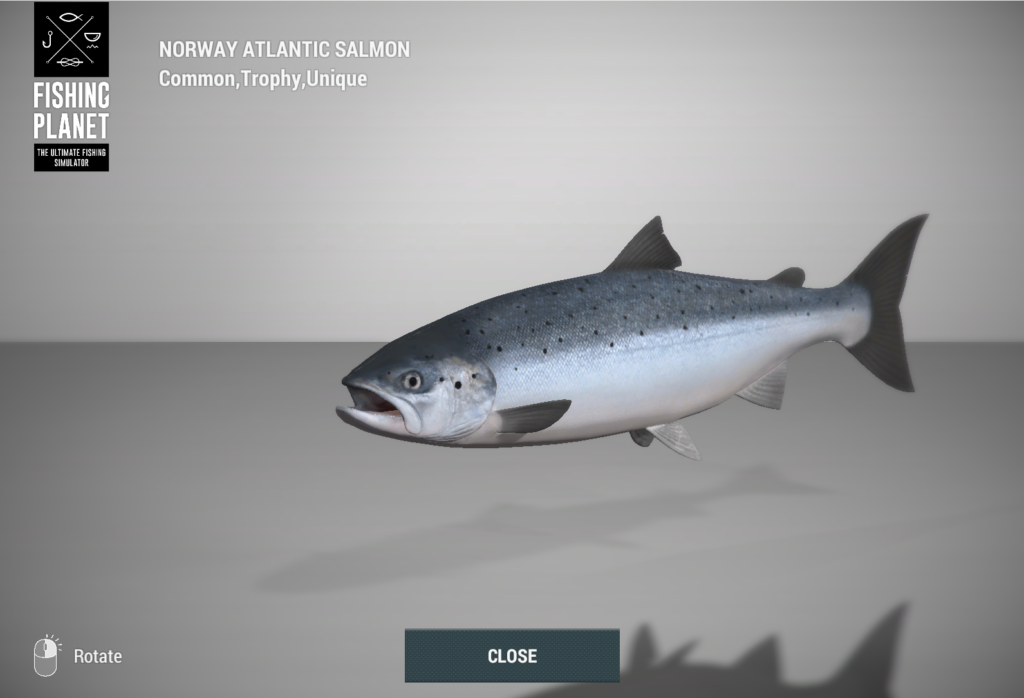
Norway Atlantic Salmon
The iconic salmon, and thanks to Norway’s rich food supply it grows larger here than almost anywhere. Most run a healthy few kilos, but the giants are exceptional, and they are sharp-eyed and cautious, which means delicate, nearly invisible rigs and precise presentation genuinely matter. In open coastal water, trolling tends to give the best results, with Spoons, Plugs, Crankbaits, and Minnows leading the way. This is a prize catch, but it is not a bottom fish, so leave the heavy rods in the holders and bring a proper spinning or trolling outfit if you want one.
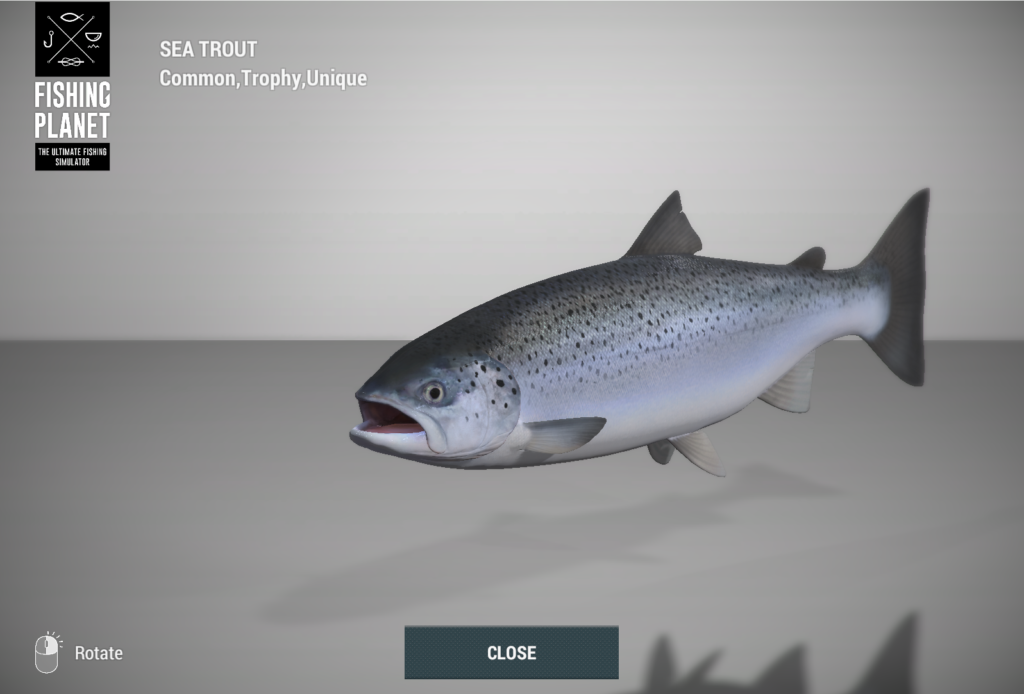
Sea Trout
A fast, agile coastal predator found in the cool water of fjords, river mouths, and along the shore, and a favourite for anyone who wants action-packed fights. It becomes especially responsive to trolling during feeding migrations, chasing sprats, herring, sardines, and shrimp. Its excellent vision means light, subtle rigs and clean presentation are key, and Spoons, Plugs, and Spinners on a spinning rod are the way in. Like the salmon, this is a surface and coastal fish, so the bottom rigs will never reach it.
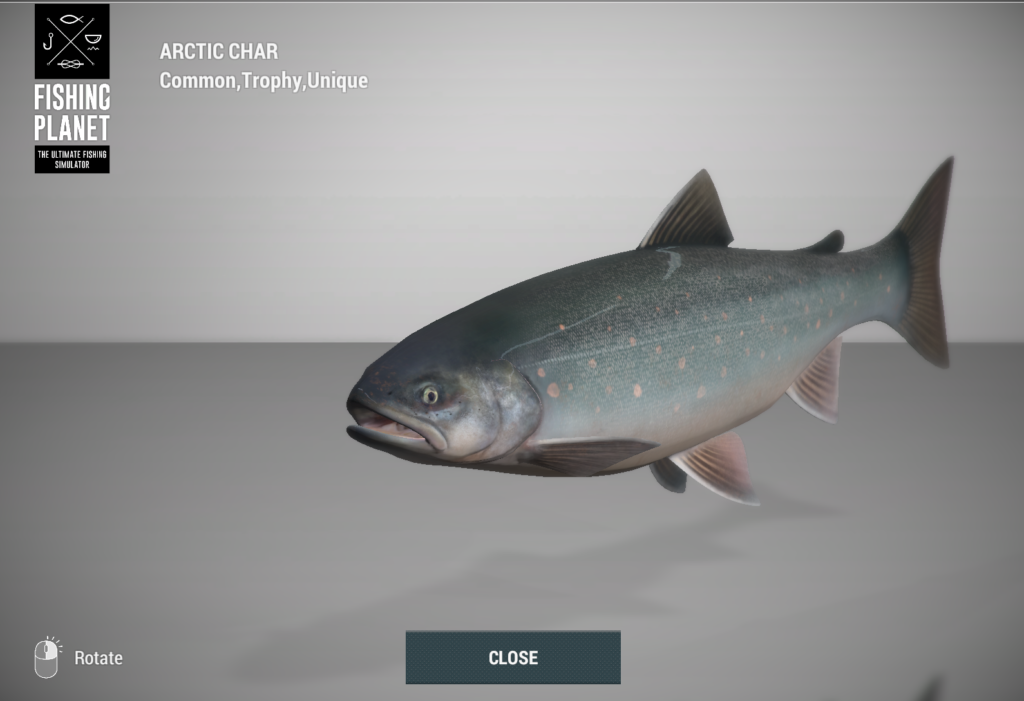
Arctic Char
A cold-water predator that usually keeps to highland lakes and rivers but sometimes follows baitfish out to sea, which makes it a welcome surprise in coastal trolling. It feeds on small fish, insect larvae, and invertebrates, and it reacts well to both live bait and artificial lures. Spoons, spinners, and small crankbaits on a spinning rod are the approach, and it rewards a technical, finesse style rather than brute force. Not the easiest fish here, but a satisfying one for anglers who enjoy the careful side of the game.
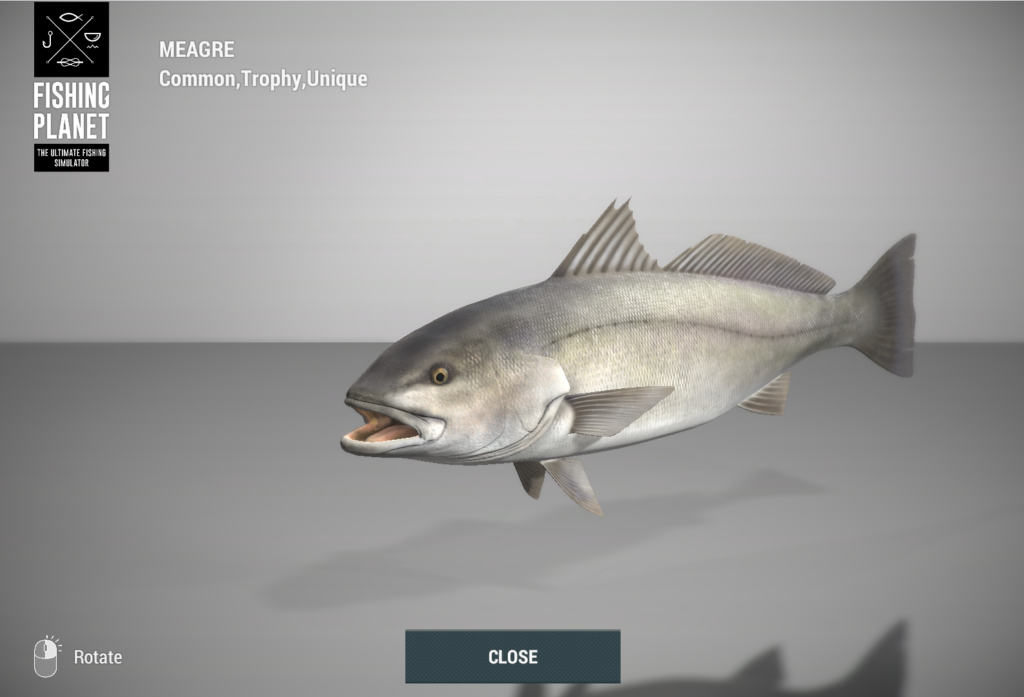
Meagre
Sometimes called a salmon-bass, the meagre is a powerful coastal predator known for its silvery sheen and hard-fighting nature, and it is easily the most flexible fish on this list. It thrives in well-oxygenated water and can hold near the bottom, in the mid-water, or up near the surface, feeding on sardines, cod, shrimp, and mollusks. This fish takes both natural baits and large lures, and it is most active on early morning and evening tides, so time your session around those windows. Its sharp senses reward fresh bait and a quiet presentation, and you can target it by trolling, spinning, or classic bottom rigs, whichever suits the day. Expect a strong fight when one commits.
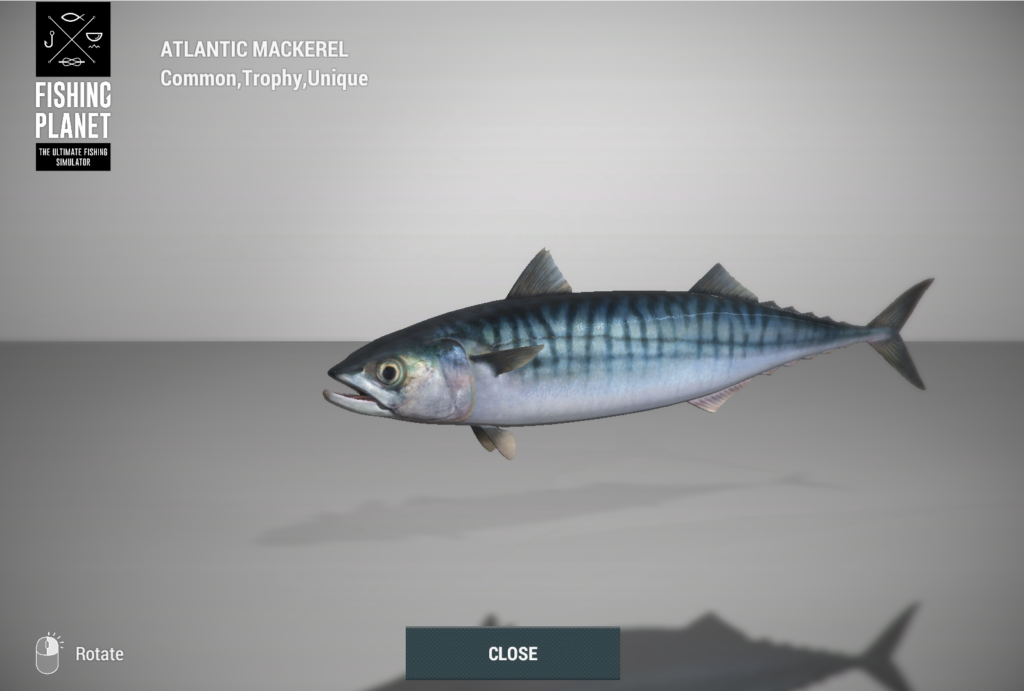
Atlantic Mackerel
A fast schooling predator that ranges from the surface down to around 200 metres and strikes hard and fast, which makes it excellent sport on light spinning gear. It feeds mainly on planktonic crustaceans, so small flashing lures do the trick: Nano Spoons and small softbaits near the surface are ideal. This is not a coin machine, and most are modest in size, but a school on the feed is fast, lively fishing and a nice change of pace from grinding the bottom. Keep the lure moving and stay on the school.
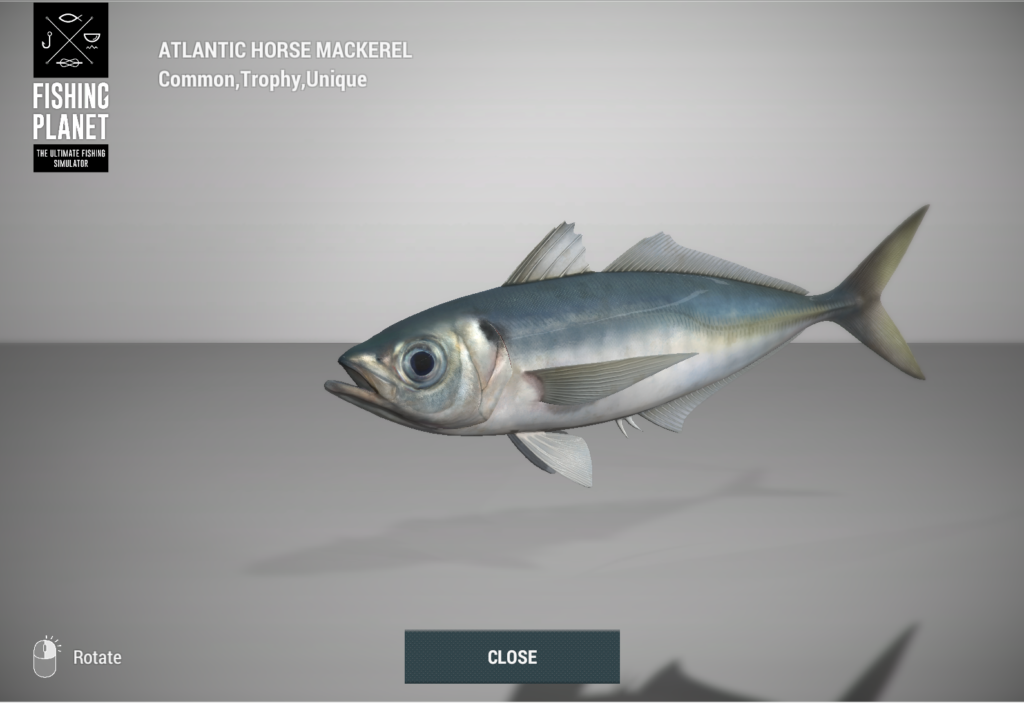
Atlantic Horse Mackerel
Another fast schooling fish, usually holding near reefs and underwater structure, though it will also rise closer to the surface. It feeds on small fish, shrimp, zooplankton, and worms, and it responds well to light spinning and fast-moving lures like Mini Cranks, Nano Spoons, and small softbaits. Its quick strikes and lively resistance make it fun and accessible, and it fishes much the same way as its cousin the mackerel. Find the structure, keep the retrieve brisk, and the bites come quickly.
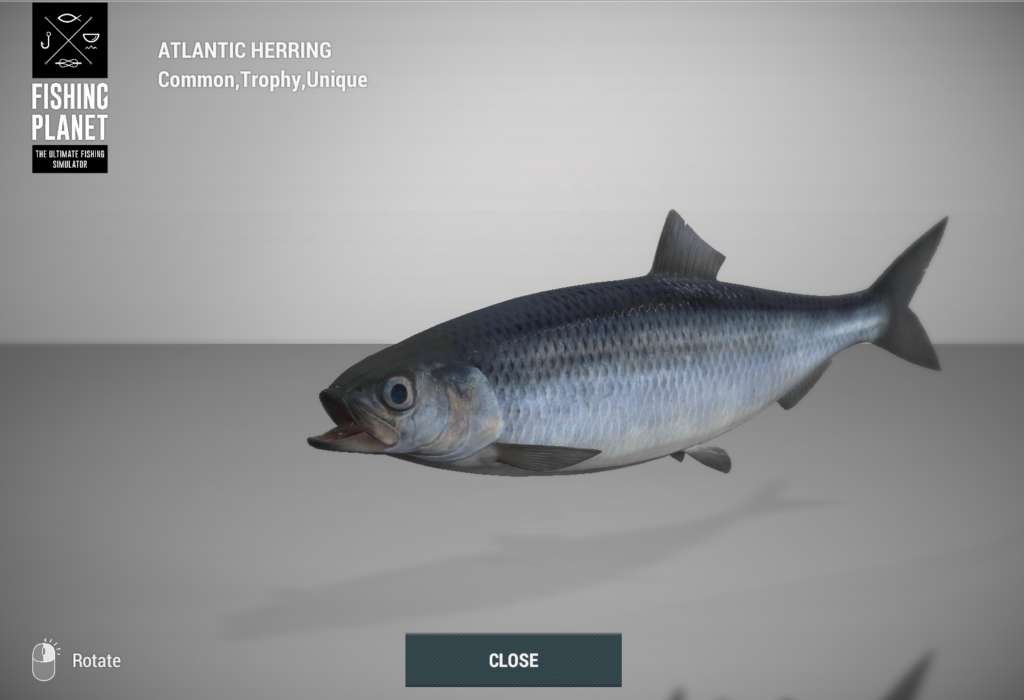
Atlantic Herring
The baitfish that half the map is chasing, and worth catching in its own right on tiny flashing lures. It travels in dense, fast-moving shoals through coastal water, fjords, and shallows, usually between roughly 10 and 200 metres, feeding on zooplankton and small fish. Bright micro-lures are the key: Nano Spoons, Nano Spinners, and small softbaits that mimic its natural food. Beyond being a catch, landing a few herring tells you exactly what the cod, halibut, and sharks are keying on, which is useful intel for the rest of your session.
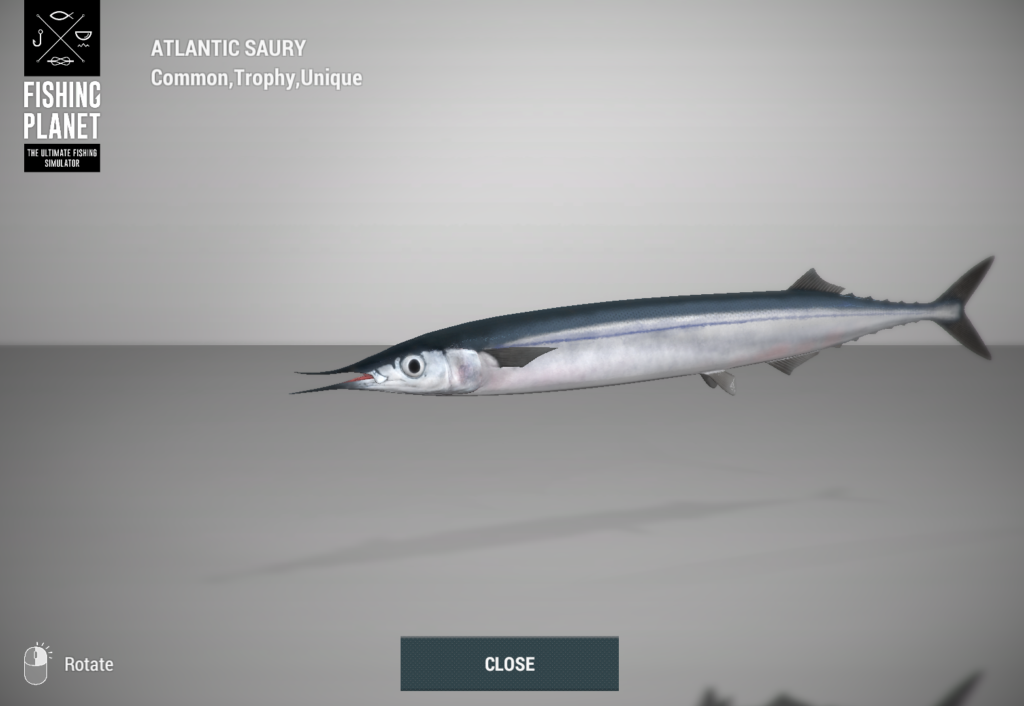
Atlantic Saury
A slender, fast surface fish that roams the open water and coastal zones, usually staying within about 30 metres of the surface. It forms schools that move in sync with seasonal plankton blooms, feeding on small crustaceans, krill, and fish larvae, and it responds best to fast-moving small soft-bait lures. With its speed and energy, it offers quick, active fishing whenever a school pushes up top. Keep your lure small and moving, and stay mobile to stay on the fish.
Monster Fish: Fenrivore and Helgaflut
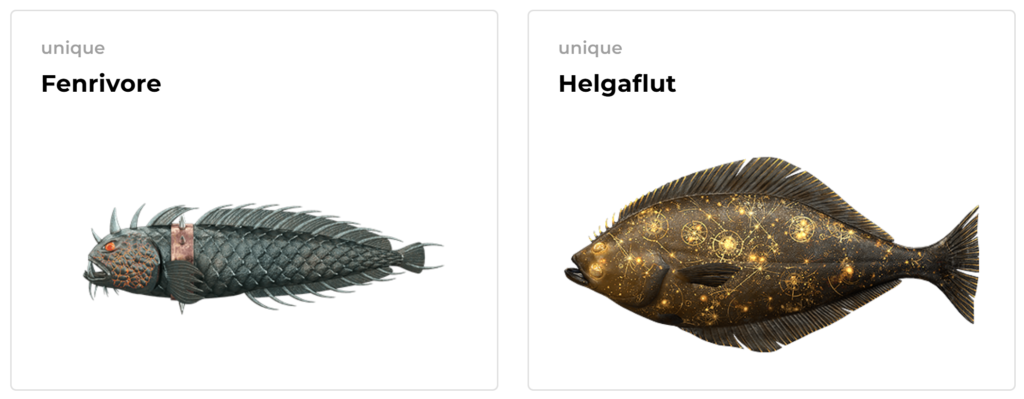
Skårland Fjord carries two unique monster fish: Fenrivore, a nightmarish spined creature, and Helgaflut, a huge, golden-flecked flatfish. These are special one-off catches, not something you farm. Treat them the way you treat the Greenland Shark: heavy gear on the bottom, the right big bait, and the willingness to sit through a lot of nothing for one unforgettable fight. If you land either, that is the catch screenshot your whole page should be built around.
Common Mistakes at Skårland Fjord
Arriving underfunded is the classic one. This is a 50,000-coin trip before licenses and bait, and running out of money mid-session means leaving before the good tide. Budget like the map is expensive, because it is.
Using fluorocarbon on toothy fish is the mistake that costs trophies. Wolffish, dogfish, and sharks will cut straight through it. If you are targeting anything with teeth, the steel leader goes on. That is the entire reason the Chillarc exists in my kit.
Bringing only one rod is a trap on a map with this weight range. A rig built for cod will get destroyed by a shark, and a rig built for a shark will barely register a cod bite. The three-rod system is not showing off; it is how you actually cover the fjord.
And fishing the wrong water for your target. Cod, ling, and haddock live over the busy shelf; the true giants sit along the deep drop-off. Anchoring in the wrong depth for what you want is the quiet reason a lot of sessions feel slow.
Where Skårland Fjord Fits in Your Progression
Skårland Fjord is an endgame destination, not a stepping stone. By Level 105 you should already have a boat, electric reels, and the coin base to absorb an expensive map. If you are building toward it, the smart path is to master the early waterways first by working through the Level 5 spinning setup, the Level 6 casting setup, and the Level 8 feeder setup, so you arrive here with skills and savings instead of debt. If you learned the game before mid-2026, also read up on the First Levels Rework, because a lot of early-game advice changed.
Once you are here, the loop is simple: run the Sigma F for steady cod-family coins, keep the Chillarc ready for anything toothy that shows up, and put the PulseWave down when you are ready to commit to a shark. Skårland Fjord is the kind of map you keep coming back to, because there is always a bigger fish in that cold water waiting to test your gear.
Frequently Asked Questions
What level do you need for Skårland Fjord in Fishing Planet?
Skårland Fjord unlocks at Level 105. It is an endgame saltwater map in the Sørfold region of Norway, so you will also need a boat and the coins to cover a 50,000-coin travel cost plus a fishing license before you can fish it properly.
What is the best rod setup for Skårland Fjord?
There is no single best rod because the fish range from 1 kg to 700 kg. I run three saltwater bottom casting electric rods: the Sigma F 200 NE SE for the cod family, the Chillarc 180 SE with a steel leader for toothy predators and sharks, and the PulseWave 170 SE with Seal Blubber for Greenland Shark and the biggest fish on the map.
How do you catch a Greenland Shark at Skårland Fjord?
Use your heaviest bottom rig. For me that is the PulseWave 170 SE with a #15/0 hook, a heavy sinker, and Seal Blubber (Fish Head and Large Fish Strips also work). Anchor over the deep channel along the drop-off and be patient, because the Greenland Shark rarely takes bait and is one of the hardest catches in the game.
Do you need the Advanced license at Skårland Fjord?
Not always. The Basic Sørfold license (from 15,000 coins per day) is fine for a session focused on cod-family fish. The Advanced license (from 22,000 per day) is worth it if you are targeting the premium deep species and keeping trophies. Buy the shortest pass that fits your plan, and never fish without one, because the fine is 7,000 coins per violation.
What are the monster fish at Skårland Fjord?
Skårland Fjord has two unique monster fish: Fenrivore and Helgaflut. Both are rare one-off catches best pursued with heavy bottom gear and big baits, the same way you would hunt the Greenland Shark.
Can you catch salmon and mackerel at Skårland Fjord?
Yes, but not with a bottom setup. Norway Atlantic Salmon, Sea Trout, Arctic Char, Mackerel, Horse Mackerel, Herring, and Saury are pelagic or coastal fish that need a saltwater spinning rod with light lures such as spoons, spinners, and nano baits. Bring a separate spinning outfit if these are your target.