
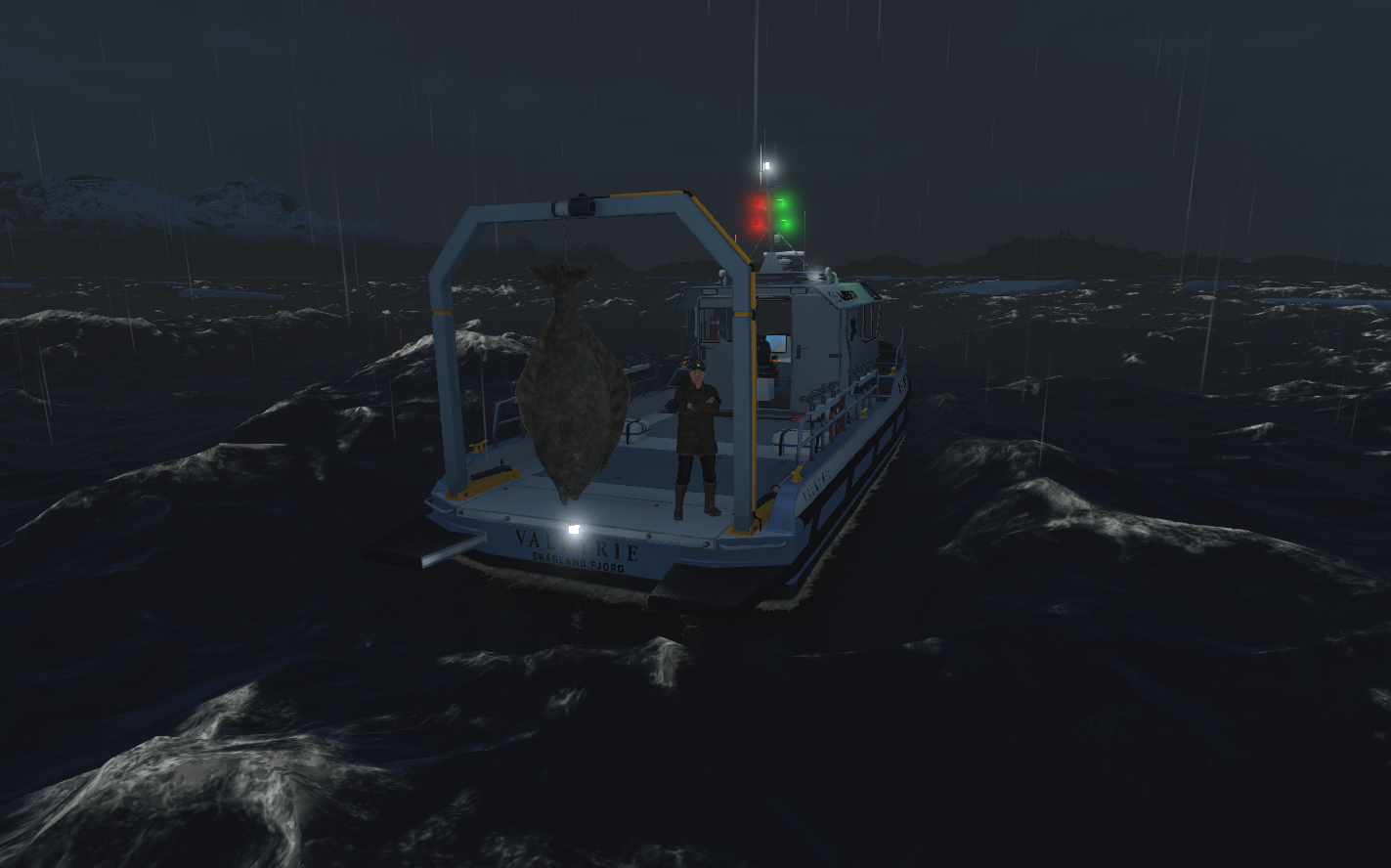
The Atlantic Halibut is the fish the Norwegian Sea is proudest of. The game calls it the most sought after trophy in cold northern waters, and after landing a Unique at 250.625 kg and 271.8 cm for 85,223 coins and 137,069 XP, I understand why. That XP figure is the second highest of any fish I have caught at Skårland Fjord, behind only the sturgeon. This guide covers the central-eastern water where it holds, the fight it puts up, and a rig that will look very familiar if you have already read my sturgeon guide.
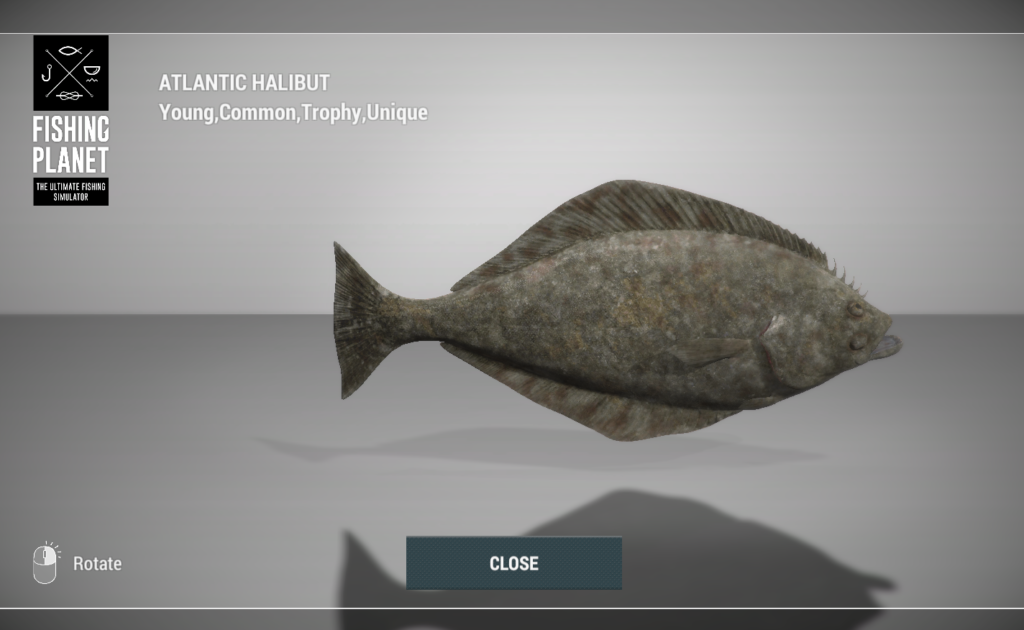
A Top XP Earner
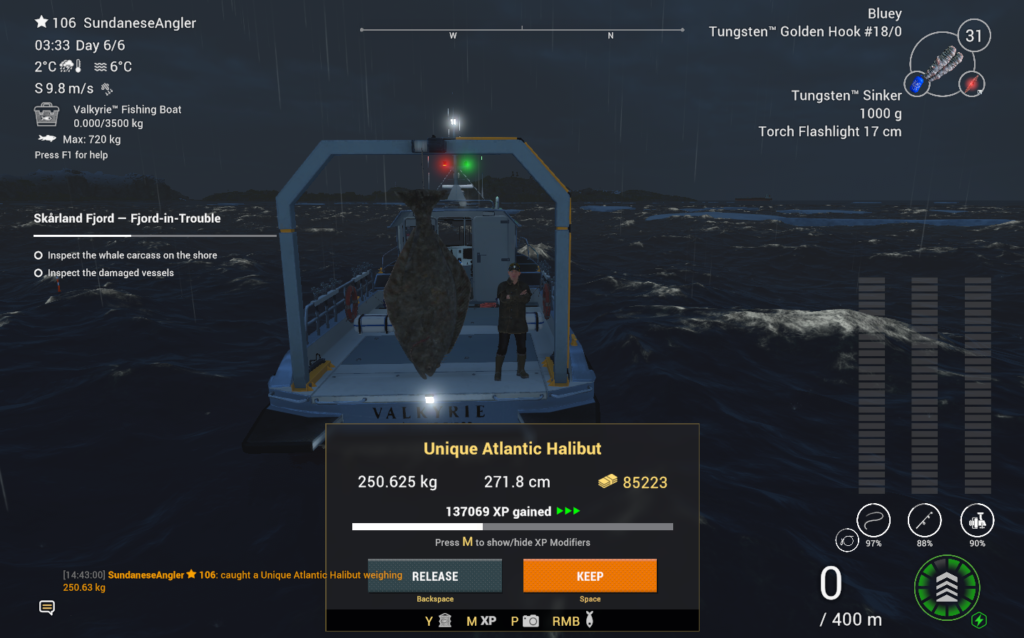
My Unique paid 85,223 coins and 137,069 XP. The coin figure sits below the Greenland Shark and the sturgeon, but the XP is the story here: at 137,069 it is the second best single-fish XP I have logged on this map. If you are pushing levels rather than filling your wallet, the halibut is one of the most rewarding fish at Skårland Fjord.
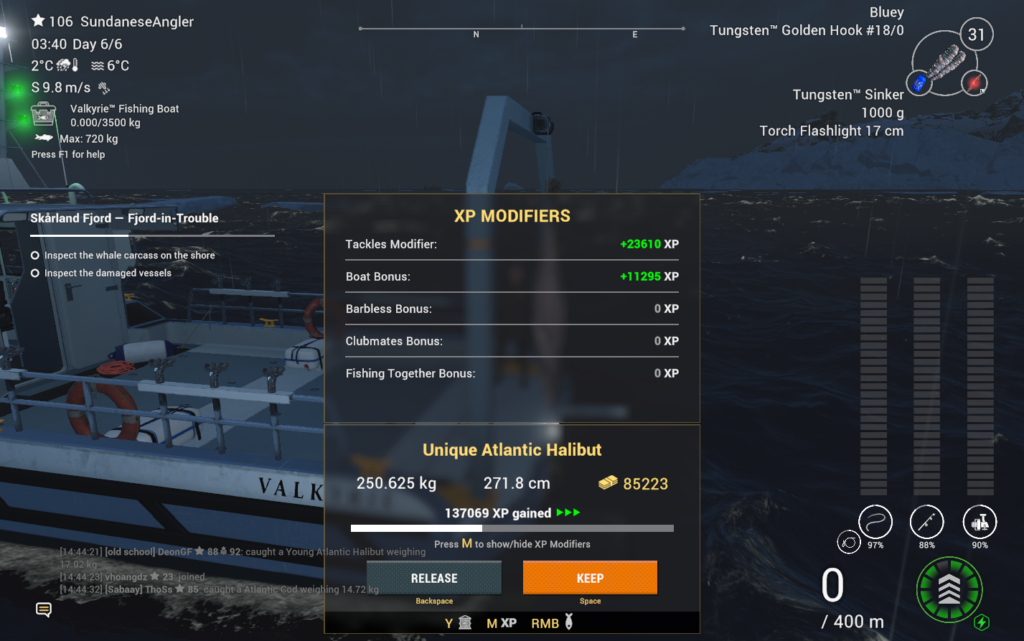
Worth pointing out, because it applies to every big fish out here: a chunk of that XP came from modifiers, not the base catch. On this fish my Tackles Modifier added 23,610 XP and the Boat Bonus added another 11,295. In other words, using premium tackle and fishing from the Valkyrie is quietly boosting every catch. If you are grinding XP, those bonuses are a real reason to fish the good gear rather than the minimum that will land the fish.
For the full map see my Skårland Fjord setup guide. The top XP fish is covered in my European Sea Sturgeon guide, and the top coin fish in my Greenland Shark guide.
About the Atlantic Halibut
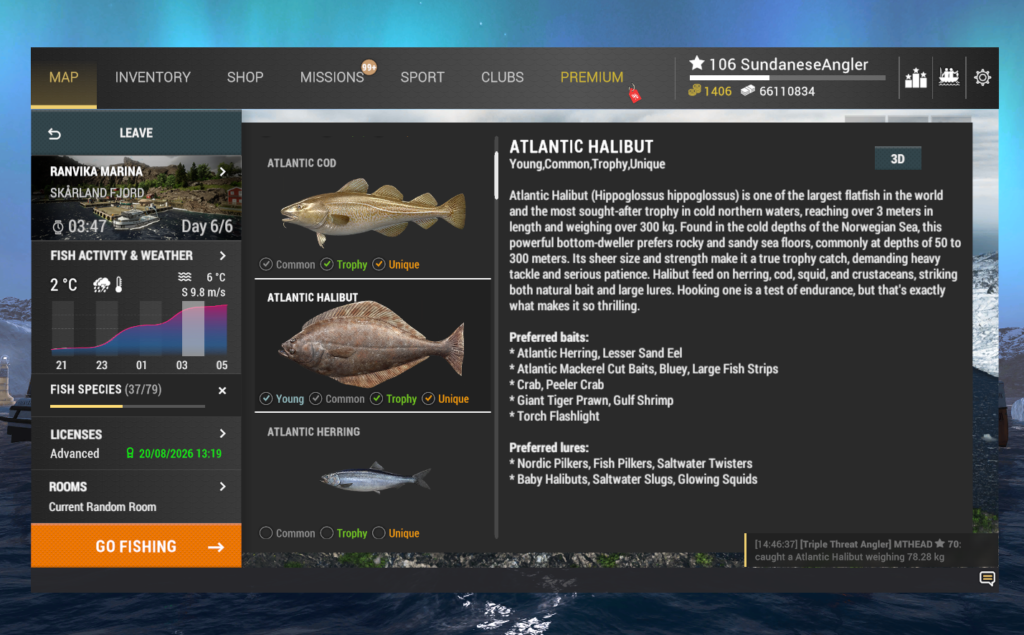
The Atlantic Halibut is one of the largest flatfish in the world, reaching over 3 metres and 300 kg. It is a powerful bottom dweller of the Norwegian Sea that prefers rocky and sandy sea floors, usually at depths of 50 to 300 metres. It feeds on herring, cod, squid, and crustaceans, and it will strike both natural bait and large lures. The game is honest that hooking one is a test of endurance, and that endurance is the whole appeal.
What makes a flatfish this size interesting to fight is that it does not run like the sharks do. It uses its huge flat body as a brake against you, so the fight is less about chasing line screaming off the reel and more about steady, stubborn lifting. It comes in Young, Common, Trophy, and Unique classes. Mine was a Unique, which is the top class, so treat my numbers as the ceiling rather than a typical first catch.
Where to Catch Atlantic Halibut at Skårland Fjord
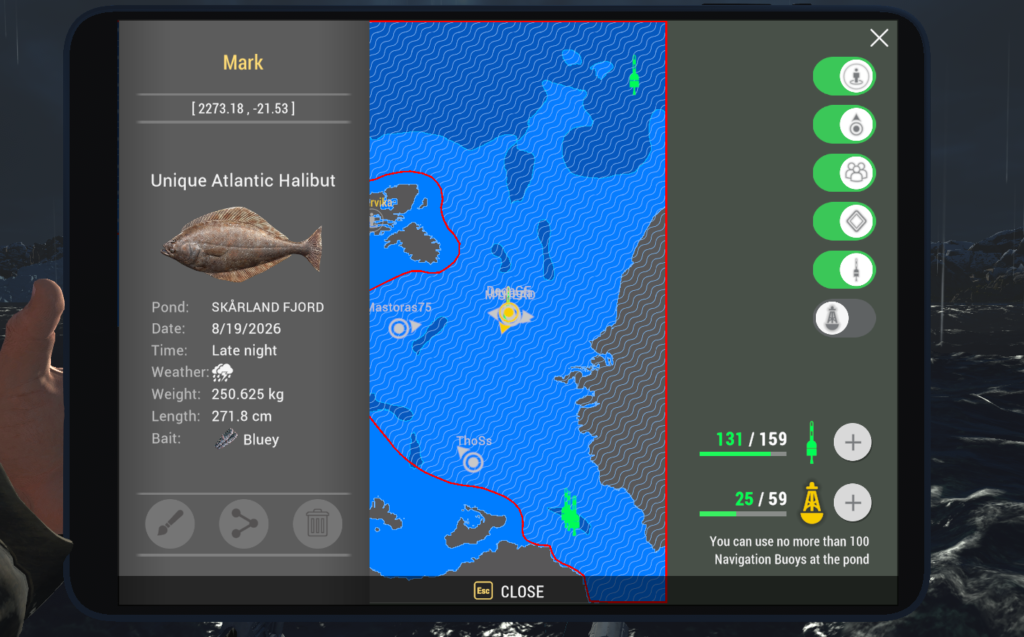
This is a fourth distinct area on the map, and getting the zone right matters as much as the rig. I marked and caught mine near coordinates 2273, -21, out in the central-eastern open water. That is its own ground, well north of the far south-eastern shark water where the Porbeagle and Greenland Shark hold, and nowhere near the northern Ranvika marina fish or the deep southern sturgeon spot. If you have been treating Skårland Fjord as one big lake, this is the trip that teaches you it is really several fisheries in one.
Run the boat out to this central-eastern water, drop a marker buoy so you can hold position, and work the rig hard on the bottom over the rocky and sandy floor the halibut favours. As with every big fish here, the exact coordinate is a starting area rather than a precise pixel, so give yourself room to recast around the buoy.
Timing: Late Night into Pre-Dawn
I took mine at 03:33, logged as Late night, at 2°C air and 6°C water with a strong southerly around 9.8 m/s. The map activity chart for that session rose steadily through the dark hours and was climbing toward a peak in the 03:00 to 05:00 window, the pre-dawn stretch where my fish took.
That chart shows generalised bite rate rather than a halibut specific curve, so read it as a pointer. Still, the pattern here is consistent with what I have seen across Skårland Fjord: the low light hours at the edges of night are when the big fish move. Reach that window with Forward Time, and steer clear of Next Day, which sells your whole storage.
The Rig: My Sturgeon Setup, One Change
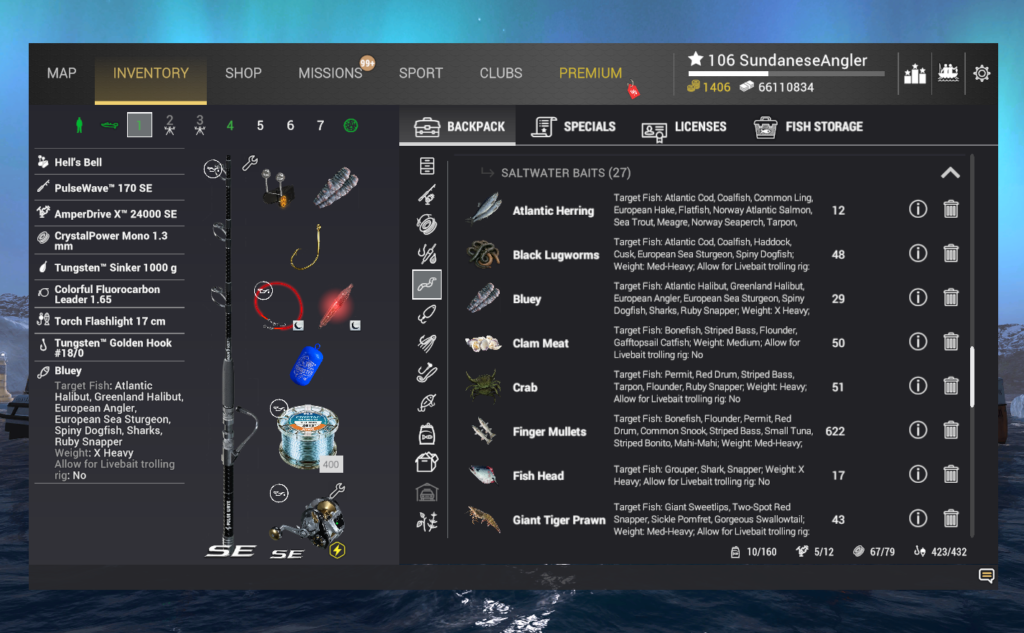
I will be straight with you: this is the same heavy rig I use for the European Sea Sturgeon, with a single change. If you already own that setup, you are ready for halibut right now. Here is what landed the fish:
- Rod: PulseWave 170 SE
- Reel: AmperDrive X 24000 SE
- Main line: CrystalPower Mono 1.3 mm, 400 m spooled
- Leader: Colorful Fluorocarbon Leader 1.65
- Hook: Tungsten Golden Hook #18/0
- Sinker: Tungsten Sinker 1000 g
- Teaser: Torch Flashlight 17 cm
- Bait: Bluey
The only difference from my sturgeon rig is the main line, a CrystalPower Mono 1.3 mm here in place of the Glowing Mono. Everything else, the rod, reel, leader, the big #18/0 hook, the 1000 g sinker, the torch teaser, and the Bluey bait, is identical. For a full breakdown of why each part is chosen, see the rig section of my sturgeon guide, because the reasoning is the same. The short version: this is a heavy bottom outfit built to plant a large bait on the seabed in deep water and hold a fish that fights with pure weight.
That shared rig is genuinely useful to know. One heavy outfit on your deck covers both the halibut and the sturgeon, two of the three best XP fish on the map. You are not building anything new to add halibut to your rotation.
The Torch Flashlight Is Listed as a Halibut Attractor
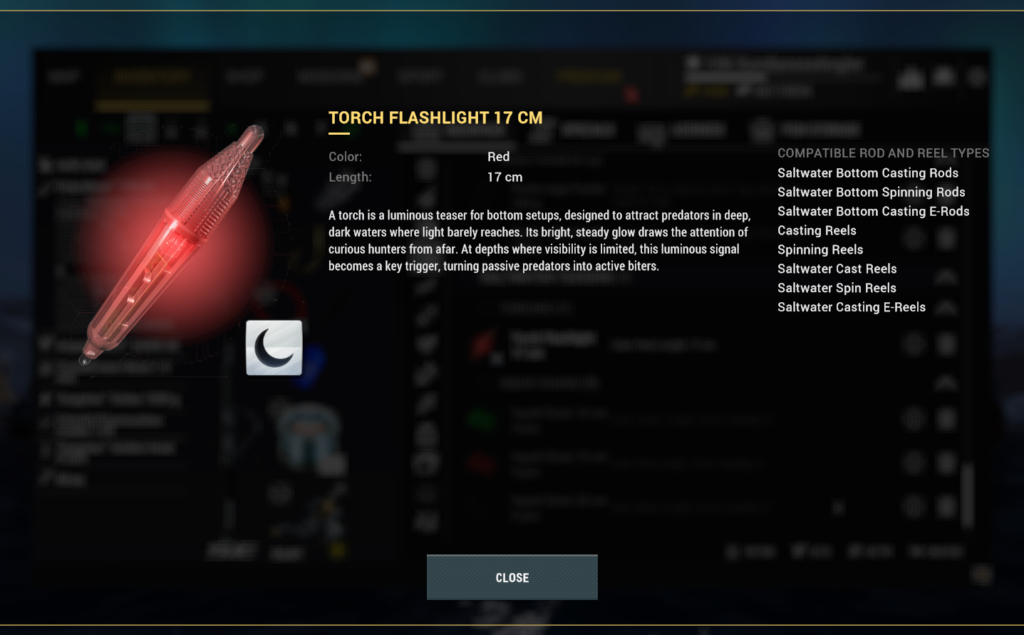
One detail worth flagging: the halibut actually lists the Torch Flashlight among its preferred items, not just as a nice-to-have. The game describes the torch as a luminous teaser for deep dark water, where its steady glow pulls in curious hunters and turns passive predators into active biters. On a fish that lives at 50 to 300 metres, that glow is doing real work. Run it.
Bait: Bluey, and Why Halibut Gives You More Options
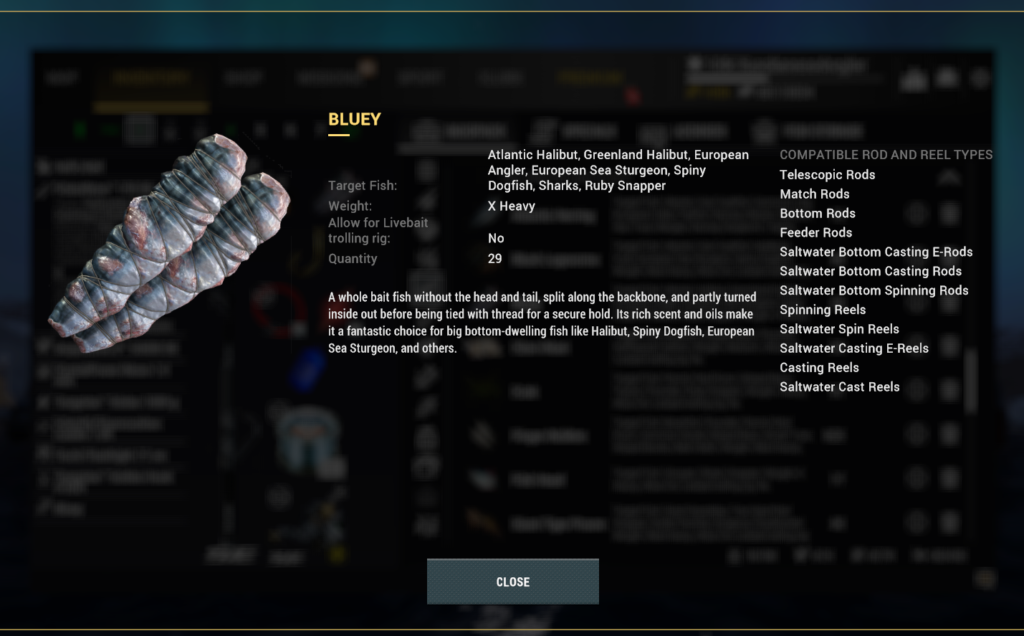
Bluey caught mine. It is a whole bait fish with the head and tail removed, split along the backbone and partly turned inside out, so its rich scent and oils leak into the water. The game names it a fantastic choice for big bottom dwellers like Halibut, Spiny Dogfish, and European Sea Sturgeon, and it is rated X Heavy, ideal for a rig meant to sit on the seabed. It is the same bait I run for the sturgeon, which is why a single pack of Bluey earns its space in the backpack.
Here is where the halibut differs from the sturgeon, though. It is far less fussy about how you fish it. Beyond Bluey it takes Atlantic Herring, Lesser Sand Eel, Atlantic Mackerel Cut Baits, Large Fish Strips, Crab, Peeler Crab, Giant Tiger Prawn, and Gulf Shrimp. And unlike the sturgeon, it will readily hit lures: Nordic Pilkers, Fish Pilkers, Saltwater Twisters, Baby Halibuts, Saltwater Slugs, and Glowing Squids all work. If you prefer to fish actively and jig rather than sit on bait, the halibut lets you, and the sturgeon does not.
Landing a Quarter-Tonne Flatfish
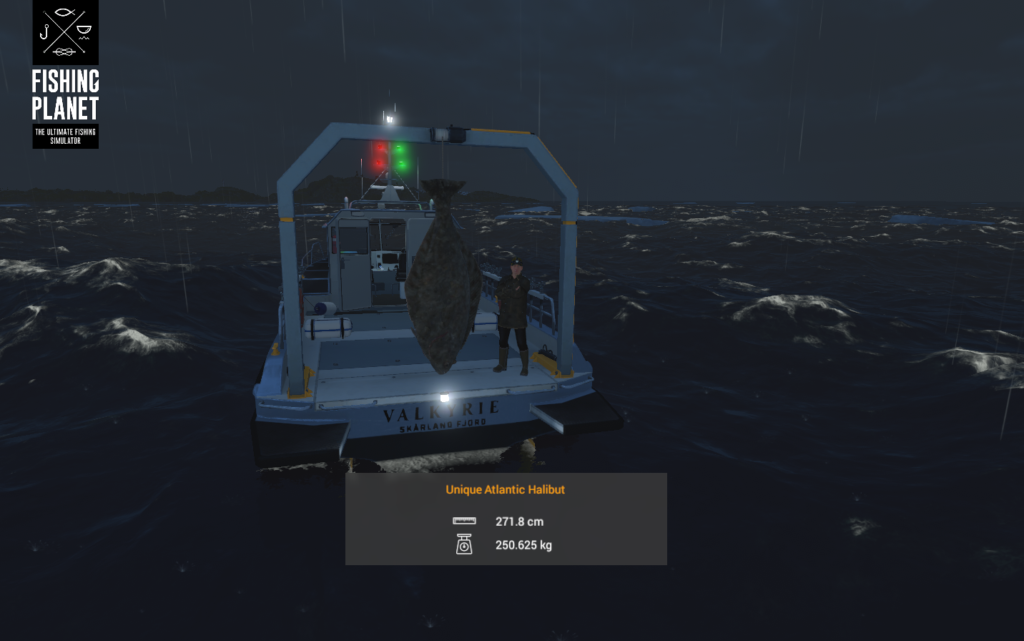
A halibut fights differently from anything else on this map. Where a shark runs, a big flatfish plants itself and turns its whole flat body sideways against your pull, which is what makes it the endurance test the game promises. Do not try to muscle it up in one go. Work it with steady pressure, let the rod load, and take line back when it gives it. At 250 kg this was well within the Valkyrie’s 720 kg single-fish limit, and the crane did the lifting at the end, as it must for a fish this size.
Common Mistakes
Fishing the wrong zone. The halibut holds in the central-eastern open water, its own ground. It is not in the shark water to the south-east or the marina water to the north. Mark the right area first.
Trying to power it in. A big flatfish uses its body as a brake. Horse it and you risk the hook or the line. Steady pressure beats brute force here.
Leaving the torch at home. The halibut lists the Torch Flashlight as a preferred attractor. In deep dark water it genuinely improves your odds, so keep it on the rig.
Overlooking lures. Unlike the sturgeon, the halibut takes lures well. If bait is slow, switch to a pilker or jig and fish actively rather than waiting it out.
Pressing Next Day. It empties your storage. Use Forward Time to reach the pre-dawn bite and keep your catch.
Fishing on an expired licence. I keep the Advanced licence current here. An expired one just turns coins into fines.